
How to Make Coffee with an Espresso Machine
How to Make Coffee with an Espresso Machine: A Complete Beginner's Guide Learning how to make coffee with an espresso machine is easier than many beginners expect. Whether you own a manual espresso machine,…
By Menu Moments
Menu Moments editorial
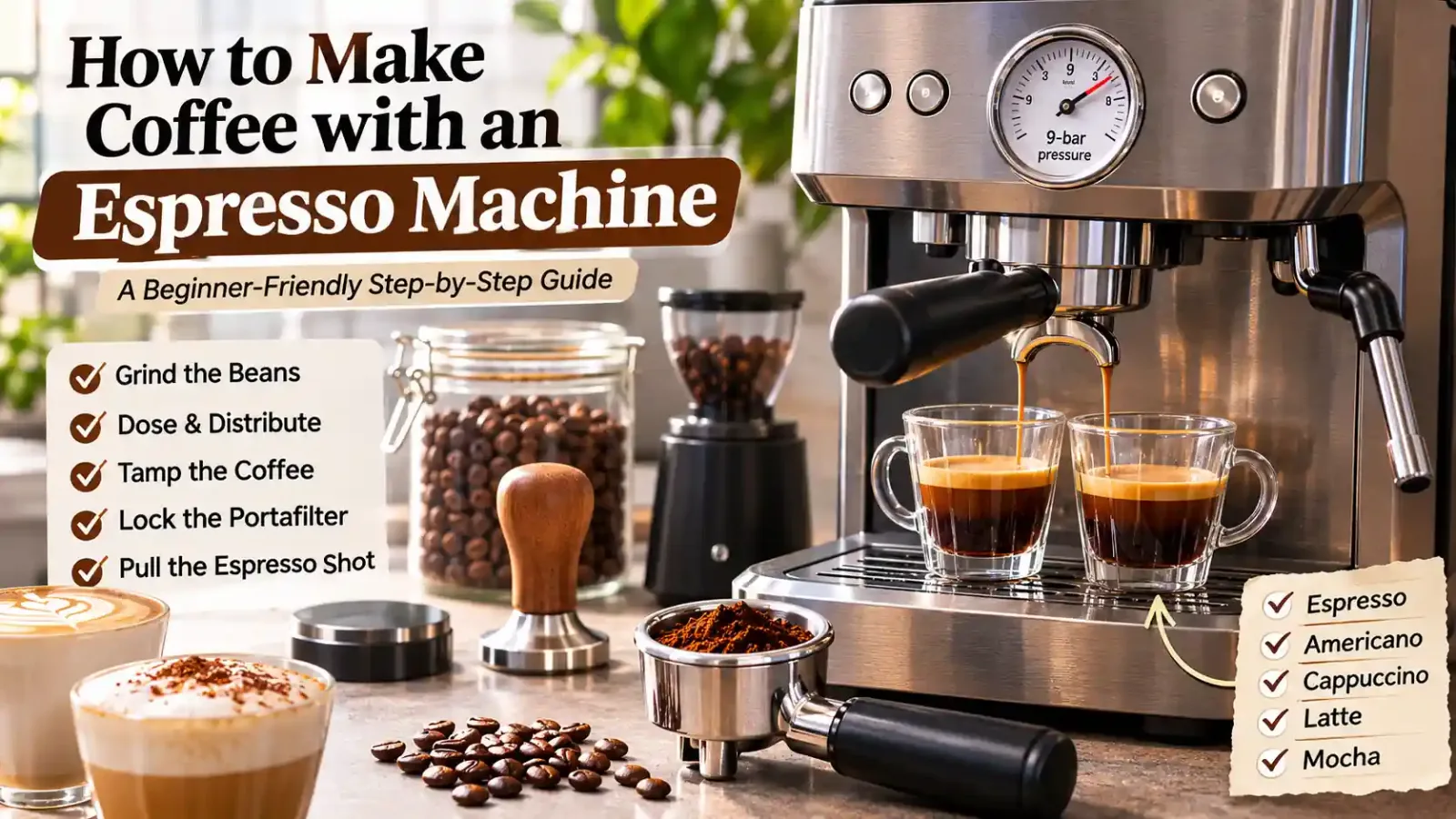
How to Make Coffee with an Espresso Machine: A Complete Beginner's Guide
Learning how to make coffee with an espresso machine is easier than many beginners expect. Whether you own a manual espresso machine, semi-automatic espresso machine, automatic espresso machine, or super-automatic espresso machine, you can prepare rich, flavorful coffee at home with the right beans, grind size, water temperature, and brewing technique.
An espresso machine uses hot water and controlled brewing pressure to extract concentrated coffee from finely ground beans. The result is espresso coffee with a rich aroma, balanced coffee flavor, and a layer of golden coffee crema. You can enjoy it as a single shot, double shot, Americano, lungo, or use it as the foundation for popular espresso-based coffee drinks such as cappuccino, latte, flat white, macchiato, and mocha.
The key to good home espresso brewing is understanding how each step affects espresso extraction. From grinding coffee beans and preparing the portafilter to tamping espresso and pulling an espresso shot, small adjustments can make a noticeable difference.
This beginner espresso guide explains how to make coffee using an espresso machine, how much coffee to use, how long to brew espresso, how to make a full cup of coffee, and how to troubleshoot common brewing problems.
What You Need to Make Coffee with an Espresso Machine
Before starting espresso brewing, gather the essential ingredients and equipment. Using fresh ingredients and properly prepared equipment helps improve espresso consistency and makes the brewing process easier.
Essential Equipment
You will need:
Espresso machine: The main equipment used to force hot water through compacted coffee grounds.
Coffee grinder: Used for grinding coffee beans to the correct espresso grind size.
Burr grinder: A preferred option because it produces more consistent coffee particles than many blade grinders.
Portafilter: The handle that holds the filter basket and ground coffee.
Filter basket: The metal basket that contains coffee grounds during extraction.
Espresso basket: Another common name for the filter basket where you place your measured coffee dose.
Coffee tamp: A tool used for compressing coffee grounds into an even coffee puck.
Distribution tool: Helps distribute coffee grounds evenly before tamping.
Digital coffee scale: Measures coffee dose and espresso yield accurately.
Espresso cups: Small cups designed to serve concentrated espresso.
Filtered water: Helps produce better-tasting coffee and reduces mineral buildup.
Ingredients for Homemade Espresso Coffee
Choose good-quality ingredients for the best results:
Freshly ground coffee beans
Whole coffee beans
Pre-ground coffee, if your grinder is unavailable
Filtered water
Fresh coffee beans are particularly important because coffee bean freshness affects aroma, flavor, and extraction quality.
For the best results, purchase whole coffee beans and grind them immediately before brewing. Look for beans specifically labeled for espresso or suitable for espresso preparation.
Step-by-Step: How to Make Coffee with an Espresso Machine
Follow these steps to prepare a delicious cup of homemade espresso coffee.
Step 1: Choose the Right Coffee Beans
The first step is selecting high-quality coffee beans.
Coffee beans have different flavor profiles depending on their origin, roast level, processing method, and freshness.
For beginners, medium-roast and medium-dark-roast coffee beans are excellent starting points. They generally offer a balanced combination of sweetness, acidity, body, and aroma.
When selecting coffee beans, consider:
Arabica beans: Often offer sweet, fruity, chocolatey, or floral flavor notes.
Robusta beans: Usually provide stronger bitterness, more body, and higher caffeine content.
Medium roast: Offers balanced flavor and moderate acidity.
Dark roast: Often produces bold, intense, chocolatey, and smoky flavors.
Espresso roast: A roast profile commonly developed for espresso brewing.
Why Fresh Coffee Beans Matter
Fresh coffee beans contain aromatic compounds that contribute to coffee flavor and coffee aroma.
As roasted beans age, they gradually lose freshness and release carbon dioxide. This can affect extraction and the final taste.
Store your beans in an airtight container away from direct sunlight, moisture, heat, and strong odors.
Step 2: Preheat Your Espresso Machine
Before preparing coffee, turn on your espresso machine and allow it to reach its operating temperature.
Preheating espresso machine components helps maintain consistent brewing conditions.
The important components include:
Boiler
Heating element
Group head
Shower screen
Portafilter
The boiler heats the water, while the heating element maintains the required temperature. The group head distributes hot water over the coffee puck, and the shower screen helps distribute water across the coffee bed.
Depending on the machine, heating may take a few minutes or longer.
Warm Your Coffee Cups
Warming coffee cups is another useful step.
You can place your cups on the machine's cup-warming tray or rinse them with hot water. This helps prevent the espresso from cooling too quickly after extraction.
Step 3: Fill the Espresso Machine Water Reservoir
Check the espresso machine water reservoir and make sure it contains enough fresh, filtered water.
Water quality is important because water makes up most of your finished coffee.
Follow these recommendations:
Use fresh, filtered water.
Avoid water with strong odors or unpleasant flavors.
Follow the manufacturer's water-hardness recommendations.
Never operate a machine without sufficient water.
Empty and refill the reservoir regularly.
Filtered water can also help reduce mineral deposits, although it does not eliminate the need for descaling espresso machine components.
Step 4: Grind Your Coffee Beans
Grinding coffee beans is one of the most important parts of espresso brewing.
The correct espresso grind size allows water to pass through the coffee puck at an appropriate rate.
For most traditional espresso machines, a fine to medium-fine coffee grind is a good starting point.
However, the ideal grind depends on your coffee beans, machine, basket, and brewing conditions.
What Grind Size Is Best for Espresso?
A medium-fine coffee grind is not always the same as the ideal grind for every espresso machine. Traditional espresso usually requires a fine grind that resembles fine table salt.
Consider these differences:
Grind size | Typical use |
|---|---|
Coarse | French press |
Medium | Drip coffee |
Medium-fine | Some espresso setups |
Fine | Traditional espresso |
Extra fine | Turkish coffee |
If your espresso flows too quickly, try adjusting grind size slightly finer. If extraction is extremely slow, try a slightly coarser grind.
Why Choose a Burr Grinder?
A burr grinder crushes coffee beans between two grinding surfaces, producing more uniform particles.
This consistency helps you achieve predictable espresso extraction.
Blade grinders chop beans into uneven pieces, which can create a mixture of fine particles and larger fragments.
For beginners who want better espresso consistency, a quality burr grinder is a worthwhile investment.
Step 5: Measure Your Coffee Grounds
Once your beans are ground, measure the coffee dose using a digital scale.
The coffee dose refers to the amount of dry coffee grounds placed inside the filter basket.
A common starting point for a double shot is 18–20 grams of coffee, depending on the basket's recommended capacity.
For a single shot, you might start with approximately 7–10 grams, although modern baskets and machine recommendations vary.
Understanding Coffee-to-Water Ratio
The coffee-to-water ratio describes how much ground coffee is used compared with the weight of the extracted espresso.
A common espresso starting ratio is 1:2.
For example:
Coffee dose | Espresso yield |
|---|---|
9 grams | 18 grams |
18 grams | 36 grams |
20 grams | 40 grams |
These are starting measurements, not strict rules.
Adjusting your coffee-to-water ratio can change coffee strength, texture, sweetness, and overall flavor.
Step 6: Prepare the Portafilter and Filter Basket
Remove the portafilter from the group head and make sure the filter basket is clean and dry.
Place the measured coffee grounds inside the filter basket.
Use a distribution tool or gently distribute the grounds with an appropriate technique to minimize clumps and uneven areas.
This process is known as puck preparation.
Good puck preparation helps water move evenly through the coffee grounds during extraction.
Step 7: Tamp the Coffee Grounds
Tamping espresso involves compressing the coffee grounds into a flat, even surface.
Place the portafilter on a stable tamping mat and position your coffee tamp directly over the grounds.
Apply firm, controlled pressure while keeping the tamper level.
A properly prepared coffee puck should have:
A flat surface
Evenly distributed grounds
No obvious gaps around the edges
No loose coffee particles on the basket rim
Avoid excessive force or uneven tamping. Consistency and a level surface are more important than trying to tamp as hard as possible.
Step 8: Lock the Portafilter into the Espresso Machine
After tamping, clean any loose coffee grounds from the portafilter edges.
Position the portafilter inside the group head and rotate it until it locks securely into place.
Make sure the handle is properly secured before starting extraction.
A loose portafilter can cause hot water or coffee to leak during brewing.
Step 9: Start Espresso Extraction
Now you are ready to begin brewing.
Place your warmed espresso cup underneath the portafilter spouts.
Start the machine and allow hot water to pass through the coffee puck.
This process is called espresso extraction.
A typical starting point for a double espresso is:
Coffee dose: 18 grams
Espresso yield: 36 grams
Extraction time: 25–30 seconds
Brewing pressure: approximately 9-bar pressure
Water temperature: approximately 90–96°C (194–205°F)
These measurements are common starting guidelines. Actual settings depend on your espresso machine and coffee beans.
Understanding Brewing Pressure
Brewing pressure helps push hot water through the compacted coffee grounds.
Traditional espresso brewing commonly uses approximately 9-bar pressure at the coffee puck.
Some espresso machines advertise higher pump pressure, but higher pressure does not automatically mean better espresso.
Consistent pressure, suitable grind size, proper dosing, and even puck preparation are more important.
Understanding Extraction Time
Extraction time measures how long water takes to pass through the coffee puck.
For a typical double shot, 25–30 seconds is a useful starting range.
However, taste should always guide your final adjustments.
If your espresso tastes sour or weak, it may be under-extracted. If it tastes harsh, excessively bitter, or dry, it may be over-extracted.
Step 10: Pulling an Espresso Shot and Checking the Crema
Once extraction begins, observe the coffee flowing into your cup.
A properly extracted shot often develops a golden-brown layer called coffee crema.
Espresso crema forms from gases and emulsified compounds released during brewing.
Good espresso crema can indicate freshness and extraction characteristics, but crema alone does not determine coffee quality.
Pay attention to:
Coffee color
Flow rate
Aroma
Texture
Flavor
Final espresso yield
When you reach your target yield, stop extraction.
You now have freshly brewed espresso coffee.
How to Make Different Types of Coffee with an Espresso Machine
One of the biggest advantages of an espresso machine is its versatility.
You can prepare several drinks using the same espresso base. Depending on your machine, you may also use the steam wand for milk frothing.
1. How to Make a Single Shot of Espresso
A single shot is a small serving of concentrated espresso.
Ingredients:
Approximately 7–10 grams of coffee
Filtered water
Preparation:
Grind fresh coffee beans.
Measure your coffee dose.
Place the grounds in a single-shot filter basket.
Distribute and tamp the coffee.
Lock the portafilter into the group head.
Start extraction.
Stop when you reach your desired yield.
Serve immediately in a preheated espresso cup.
2. How to Make a Double Shot of Espresso
A double shot contains approximately twice the coffee of a traditional single shot.
Ingredients:
18–20 grams of coffee
Filtered water
Preparation:
Grind your whole coffee beans.
Measure 18–20 grams of coffee.
Place the grounds in a double-shot filter basket.
Distribute the coffee evenly.
Tamp the coffee puck.
Lock the portafilter.
Start extraction.
Aim for approximately 36–40 grams of espresso yield.
A double shot is a popular choice for American coffee drinks and milk-based beverages.
3. How to Make an Americano
An Americano is made by combining espresso with hot water.
It offers a larger serving than traditional espresso while retaining its distinctive espresso flavor.
Ingredients:
One or two espresso shots
Approximately 120–180 ml hot water
Preparation:
Pull a single or double espresso shot.
Heat filtered water separately.
Pour hot water into a coffee cup.
Add your freshly brewed espresso.
Stir gently if desired.
Adjust the water quantity according to your preferred coffee strength.
4. How to Make a Lungo
A lungo is an espresso-based drink prepared using a longer extraction.
Unlike an Americano, which adds water after espresso extraction, a lungo uses more water during the brewing process.
Preparation:
Prepare your portafilter.
Add the measured coffee dose.
Tamp the coffee puck.
Start extraction.
Allow more water to pass through the coffee grounds than for a standard espresso.
A lungo generally produces a larger, less concentrated drink, although the longer extraction can bring out additional bitterness.
5. How to Make a Ristretto
A ristretto is a shorter, more concentrated espresso extraction.
It uses a similar coffee dose to a standard espresso but produces a smaller yield.
Preparation:
Prepare a normal espresso dose.
Grind and tamp your coffee.
Lock the portafilter.
Start extraction.
Stop earlier to produce a smaller volume.
A ristretto can offer an intense flavor with a different balance of sweetness, acidity, and bitterness.
6. How to Make a Cappuccino
A cappuccino combines espresso, steamed milk, and milk foam.
Ingredients:
One or two espresso shots
Steamed milk
Milk foam
Preparation:
Prepare fresh espresso.
Pour cold milk into a milk pitcher.
Use the steam wand to heat and aerate the milk.
Create a smooth layer of microfoam.
Pour the steamed milk over the espresso.
Finish with a layer of milk foam.
7. How to Make a Latte
A latte contains espresso and steamed milk with a relatively thin layer of foam.
It has a smooth, creamy texture and a mild coffee flavor.
You can learn the complete preparation process in our guide on how to make a latte with an espresso machine.
8. How to Make a Flat White
A flat white combines espresso with steamed milk and a thin layer of microfoam.
It typically has a stronger coffee-to-milk impression than a larger latte.
Preparation:
Prepare a double espresso.
Steam milk until smooth and glossy.
Pour the milk slowly into the espresso.
Finish with a thin layer of microfoam.
9. How to Make a Macchiato
A macchiato is an espresso drink marked with a small amount of milk or milk foam.
Prepare a single or double espresso and add a small spoonful of steamed milk foam.
This drink is ideal for people who enjoy the strong taste of espresso with a little milk.
10. How to Make a Mocha
A mocha combines espresso, chocolate, and milk.
Ingredients:
One or two espresso shots
Chocolate syrup or cocoa
Steamed milk
Optional whipped cream
Preparation:
Prepare your espresso.
Add chocolate syrup or cocoa to a cup.
Pour the espresso over the chocolate.
Stir until combined.
Add steamed milk.
Finish with whipped cream if desired.
Can You Make Regular Coffee with an Espresso Machine?
Yes, you can make regular coffee-style drinks with an espresso machine, but the result is different from traditional drip coffee.
An espresso machine is designed to produce concentrated coffee through pressurized extraction. A drip coffee maker, on the other hand, allows hot water to pass through coffee grounds using gravity.
If you want a larger cup, you can prepare an Americano or lungo.
Can an Espresso Machine Make Normal Coffee?
Yes. You can make a coffee drink that resembles normal black coffee by combining espresso with hot water.
An Americano is usually the easiest option.
However, an espresso machine does not automatically produce traditional drip coffee unless it includes a dedicated coffee-brewing function.
How to Make a Full Cup of Coffee with an Espresso Machine
If you want a full 8–12-ounce cup of coffee, an Americano is a practical option.
Ingredients:
One or two espresso shots
6–10 ounces of hot water
Instructions:
Prepare one or two espresso shots.
Heat filtered water.
Add hot water to a large coffee mug.
Pour the espresso into the mug.
Stir gently.
Adjust the water according to your preferred coffee strength.
This is an easy way of making black coffee with an espresso machine.
Brewing Regular Coffee with an Espresso Machine: Americano vs. Lungo
Feature | Americano | Lungo |
|---|---|---|
Preparation | Espresso plus hot water | Longer espresso extraction |
Coffee strength | Adjustable | Depends on extraction |
Flavor | Often smoother | Can be more bitter |
Water addition | After extraction | During extraction |
Serving size | Easily adjustable | Depends on machine |
If your goal is a larger, balanced cup, an Americano is generally the better starting point.
Understanding Different Types of Espresso Machines
Different espresso machines offer different levels of control.
Understanding their features can help you choose the right equipment for your home.
Manual Espresso Machine
A manual espresso machine gives the user greater control over the brewing process.
You may need to control water flow and extraction pressure manually, depending on the machine.
It is suitable for enthusiasts who enjoy experimenting with espresso brewing.
Semi-Automatic Espresso Machine
A semi-automatic espresso machine allows you to control grinding, dosing, tamping, and extraction timing while the machine manages water pressure.
It is a popular choice for home espresso brewing.
Automatic Espresso Machine
An automatic espresso machine usually controls the amount of water used during extraction.
It simplifies brewing while still allowing some customization.
Super-Automatic Espresso Machine
A super-automatic espresso machine handles most brewing steps automatically.
Depending on the model, it can grind coffee beans, dose coffee, tamp the grounds, extract espresso, and sometimes froth milk.
This type is convenient for beginners who want a quick and consistent coffee-making experience.
Popular Espresso Machines for Home Use
Some popular machines to consider include:
Breville Barista Express: A semi-automatic espresso machine with a built-in burr grinder.
De'Longhi espresso machine: De'Longhi offers several manual, automatic, and super-automatic models.
Gaggia Classic Pro: A home espresso machine known for its traditional espresso-making design.
Nespresso machine: Uses compatible coffee capsules rather than a traditional loose-ground coffee portafilter system.
If you are shopping for home equipment, check out our guide to the best espresso machines under $500.
How to Adjust Espresso Machine Brew Settings
The right espresso machine brew settings help you achieve a balanced cup.
However, there is no single recipe that works perfectly for every coffee bean and machine.
Start with a basic recipe and adjust one variable at a time.
Brewing variable | Suggested starting point |
|---|---|
Coffee dose | 18 grams |
Espresso yield | 36 grams |
Extraction time | 25–30 seconds |
Water temperature | 90–96°C |
Brewing pressure | Around 9 bar |
Grind size | Fine to medium-fine |
Adjusting Grind Size
Grind size is one of the easiest variables to adjust.
If coffee flows too quickly, grind finer.
If coffee flows too slowly, grind coarser.
If extraction tastes sour, try a finer grind or slightly longer extraction.
If extraction tastes harsh or dry, try a coarser grind or shorter extraction.
Make small changes and compare the results.
Adjusting Coffee Dose
Increasing coffee dose can affect the resistance of the coffee puck and the final coffee strength.
However, your dose should remain within the filter basket's recommended capacity.
For example, a basket designed for 18 grams should not be overloaded with significantly more coffee.
Adjusting Water Temperature
Water temperature affects the rate at which soluble compounds dissolve from coffee grounds.
A starting range of 90–96°C works for many espresso preparations.
Lower temperatures may produce a different flavor balance, while higher temperatures can increase extraction.
Common Espresso Brewing Mistakes and How to Fix Them
Even experienced home baristas sometimes struggle with espresso extraction.
Understanding common problems makes it easier to improve your coffee.
1. Under-Extracted Espresso
Under-extracted espresso occurs when insufficient soluble compounds are extracted from the coffee grounds.
Common signs:
Sour taste
Thin texture
Weak flavor
Sharp acidity
Possible solutions:
Use a slightly finer grind.
Increase extraction time.
Check your coffee dose.
Ensure even puck preparation.
2. Over-Extracted Espresso
Over-extracted espresso occurs when too many compounds are extracted, often resulting in an unpleasant flavor.
Common signs:
Harsh bitterness
Dry aftertaste
Unpleasant flavor
Excessively long extraction
Possible solutions:
Use a slightly coarser grind.
Reduce extraction time.
Review your coffee-to-water ratio.
Check your brewing temperature.
3. Watery Espresso
Watery espresso may result from an unsuitable coffee dose, excessive water, or an incorrect grind size.
Possible solutions:
Measure coffee grounds accurately.
Adjust espresso yield.
Use fresh coffee beans.
Check the filter basket capacity.
4. Bitter Espresso
Coffee bitterness is not always a sign of poor-quality beans. However, excessive bitterness can indicate an unsuitable extraction.
Try adjusting the grind size, extraction time, and water temperature.
5. Weak Coffee
Weak coffee can result from using too little coffee, too much water, stale beans, or incorrect espresso machine brew settings.
Use a consistent coffee dose and adjust the espresso yield to improve coffee strength.
6. Uneven Espresso Extraction
Uneven extraction can occur when coffee grounds are distributed inconsistently or the coffee puck develops channels.
To improve consistency:
Use a distribution tool.
Break up clumps before tamping.
Keep the tamper level.
Clean the filter basket.
Use an appropriate grind size.
Coffee Extraction Troubleshooting Guide
Use this table to identify possible problems and practical solutions.
Problem | Possible cause | What to do |
|---|---|---|
Espresso tastes sour | Under-extraction | Grind finer or increase extraction |
Espresso tastes bitter | Over-extraction | Grind coarser or reduce extraction |
Coffee flows too quickly | Grind too coarse | Adjust grind size finer |
Coffee flows too slowly | Grind too fine | Adjust grind size coarser |
Watery coffee | Excessive yield | Reduce water-to-coffee ratio |
Weak crema | Older beans or extraction issues | Try fresher beans |
Uneven extraction | Poor puck preparation | Improve distribution and tamping |
Coffee tastes unpleasant | Stale beans or water quality | Use fresh beans and filtered water |
How to Improve Coffee Flavor and Espresso Consistency
Making good coffee is not just about following measurements. You also need to understand how different ingredients and brewing variables influence the final drink.
Use Fresh Coffee Beans
Fresh coffee beans help preserve the natural aroma and flavor of your espresso.
Buy whole coffee beans in quantities you can use while they remain fresh.
Choose the Right Roast
Different roast levels produce different flavor profiles.
Light roast: Often brighter, more acidic, and fruitier.
Medium roast: Generally balanced and versatile.
Dark roast: Often bold, smoky, and chocolatey.
The best coffee beans for espresso depend on your personal taste and machine.
Use Filtered Water
Water quality can significantly affect coffee flavor.
Filtered water helps reduce unwanted tastes and can limit mineral deposits, depending on its composition.
Follow the water recommendations provided by your espresso machine manufacturer.
Keep Your Brewing Process Consistent
Consistency is essential for repeatable espresso brewing.
Try to maintain the same:
Coffee dose
Grind size
Espresso yield
Extraction time
Water temperature
Tamping technique
Change one variable at a time so you can understand how it affects your coffee.
Espresso Machine Cleaning and Maintenance
Regular espresso machine cleaning is important for coffee quality and equipment performance.
Coffee oils and leftover coffee grounds can accumulate inside the machine and affect the taste of future drinks.
Clean the Portafilter and Filter Basket
After every brewing session:
Remove the portafilter.
Discard the used coffee puck.
Rinse the filter basket.
Clean the portafilter.
Wipe the group head area.
Remove any visible coffee residue.
Clean the Group Head and Shower Screen
Coffee residue can accumulate around the group head and shower screen.
Flush the group head according to your machine's instructions and clean removable components as recommended by the manufacturer.
Backflushing Your Espresso Machine
Some espresso machines support backflushing.
This process uses water, and sometimes a manufacturer-approved cleaning detergent, to remove accumulated coffee oils from the internal brewing pathway.
Only backflush machines designed to support this process.
Descaling Espresso Machine Components
Mineral deposits can accumulate inside boilers, pipes, and other water-contact components.
Descaling helps remove this buildup.
The frequency depends on water hardness, usage, and manufacturer recommendations.
For detailed maintenance instructions, read our guides on how to clean an espresso machine and how to descale an espresso machine.
How Long Does It Take to Make Coffee with an Espresso Machine?
The time depends on your machine, preparation method, and the type of drink.
A typical home espresso workflow may take approximately 3–7 minutes, excluding longer machine warm-up periods.
Step | Approximate time |
|---|---|
Preheating | 2–10 minutes or longer |
Grinding beans | 10–20 seconds |
Measuring and dosing | 15–30 seconds |
Distribution and tamping | 15–30 seconds |
Espresso extraction | 25–30 seconds |
Milk frothing | 30–60 seconds |
Serving | 10–20 seconds |
Automatic machines may complete the process more quickly because they handle several steps automatically.
Frequently Asked Questions
1. How do you make coffee with an espresso machine for beginners?
Start by filling the water reservoir with filtered water and preheating your espresso machine. Grind fresh coffee beans, measure your coffee dose, distribute the grounds in the portafilter, and tamp evenly. Lock the portafilter into the group head and start extraction. A common starting recipe is 18 grams of coffee producing 36 grams of espresso in approximately 25–30 seconds.
2. How much coffee do you use in an espresso machine?
For a typical double shot, use approximately 18–20 grams of ground coffee, depending on the filter basket capacity. A traditional single shot may use around 7–10 grams. Always check the recommended dose for your machine.
3. How long should you brew espresso?
A typical espresso extraction takes approximately 25–30 seconds. However, the ideal extraction time depends on the coffee beans, grind size, dose, and desired flavor.
4. What grind size is best for espresso?
Traditional espresso generally requires a fine grind. A medium-fine coffee grind may work for certain machines and brewing setups. Adjust the grind until you achieve a balanced extraction.
5. Can I use pre-ground coffee in an espresso machine?
Yes, you can use pre-ground coffee if your espresso machine supports it. However, make sure the grind is suitable for your machine. Freshly ground coffee beans usually provide better aroma and more control over extraction.
6. Can I use regular coffee beans in an espresso machine?
Yes. You can use most whole coffee beans in an espresso machine. However, beans roasted and marketed for espresso are often easier starting points for traditional espresso brewing.
7. Can you make regular black coffee with an espresso machine?
Yes. The easiest method is preparing an Americano. Make one or two espresso shots and add hot water until you reach your preferred serving size and coffee strength.
8. How many espresso shots do I need for one cup of coffee?
For an 8–12-ounce cup, one or two espresso shots are common starting options. The ideal number depends on how strong you prefer your coffee.
9. What is the difference between espresso and regular coffee?
Espresso is made by forcing hot water through finely ground coffee under pressure. Regular drip coffee is generally brewed by passing hot water through coffee grounds using gravity. Espresso is more concentrated, while drip coffee is typically served in larger quantities.
10. Is espresso stronger than drip coffee?
Espresso is more concentrated by volume, but a full cup of drip coffee may contain more total caffeine than a single espresso shot. Caffeine content depends on the serving size, beans, and brewing method.
11. Can I make a latte with an espresso machine?
Yes. Prepare one or two espresso shots and combine them with steamed milk. Use the machine's steam wand to create smooth milk texture and a thin layer of microfoam.
12. Why does my espresso taste bitter?
Bitter espresso may result from over-extraction, an excessively fine grind, high brewing temperature, or the natural characteristics of the beans. Adjust one brewing variable at a time to identify the cause.
13. Why is my espresso watery?
Watery espresso can result from using too much water, too little coffee, stale beans, or an unsuitable grind size. Check your coffee dose and espresso yield before adjusting other settings.
14. Do I need a coffee grinder for an espresso machine?
A coffee grinder is highly recommended, especially a burr grinder. It allows you to grind whole coffee beans immediately before brewing and adjust the espresso grind size according to extraction results.
15. What is the ideal temperature for espresso brewing?
A water temperature between 90°C and 96°C (194°F and 205°F) is a common starting range. The best temperature depends on the roast, beans, and espresso machine.
16. What is the ideal pressure for espresso extraction?
Traditional espresso extraction commonly uses approximately 9-bar pressure at the coffee puck. However, pressure profiles and recommended settings can vary between machines.
17. What is espresso crema?
Espresso crema is the golden-brown foam that forms on top of freshly extracted espresso. It develops from gases and emulsified coffee compounds released during brewing.
18. Can I make coffee without grinding beans?
Yes. You can use suitable pre-ground coffee. However, fresh grinding gives you better control over particle size and usually produces a fresher aroma.
19. Is a Nespresso machine the same as a traditional espresso machine?
No. A Nespresso machine generally uses compatible coffee capsules, while a traditional espresso machine typically uses ground coffee in a portafilter or another brewing system.
20. How often should I clean my espresso machine?
Clean the portafilter and filter basket after every use. Flush and wipe the group head regularly, clean the steam wand immediately after milk frothing, and follow the manufacturer's recommended schedule for deeper cleaning and descaling.
Final Thoughts
Learning how to make coffee with an espresso machine is a practical skill that can help you enjoy café-style drinks at home without visiting a coffee shop every day.
Start with fresh whole coffee beans, a suitable espresso grind size, filtered water, and a consistent coffee dose. Pay attention to puck preparation, tamping, brewing pressure, water temperature, and extraction time.
Once you understand the basics, experiment with different coffee beans, espresso yields, and brewing techniques to find your preferred flavor.
Whether you enjoy a traditional espresso, a smooth Americano, a creamy cappuccino, or a delicious latte, a properly used espresso machine gives you plenty of ways to prepare homemade coffee.
Enjoyed this tip?
A weekly hit of kitchen know-how.
Tips, techniques and small upgrades — every Sunday.
Keep reading
You might also like
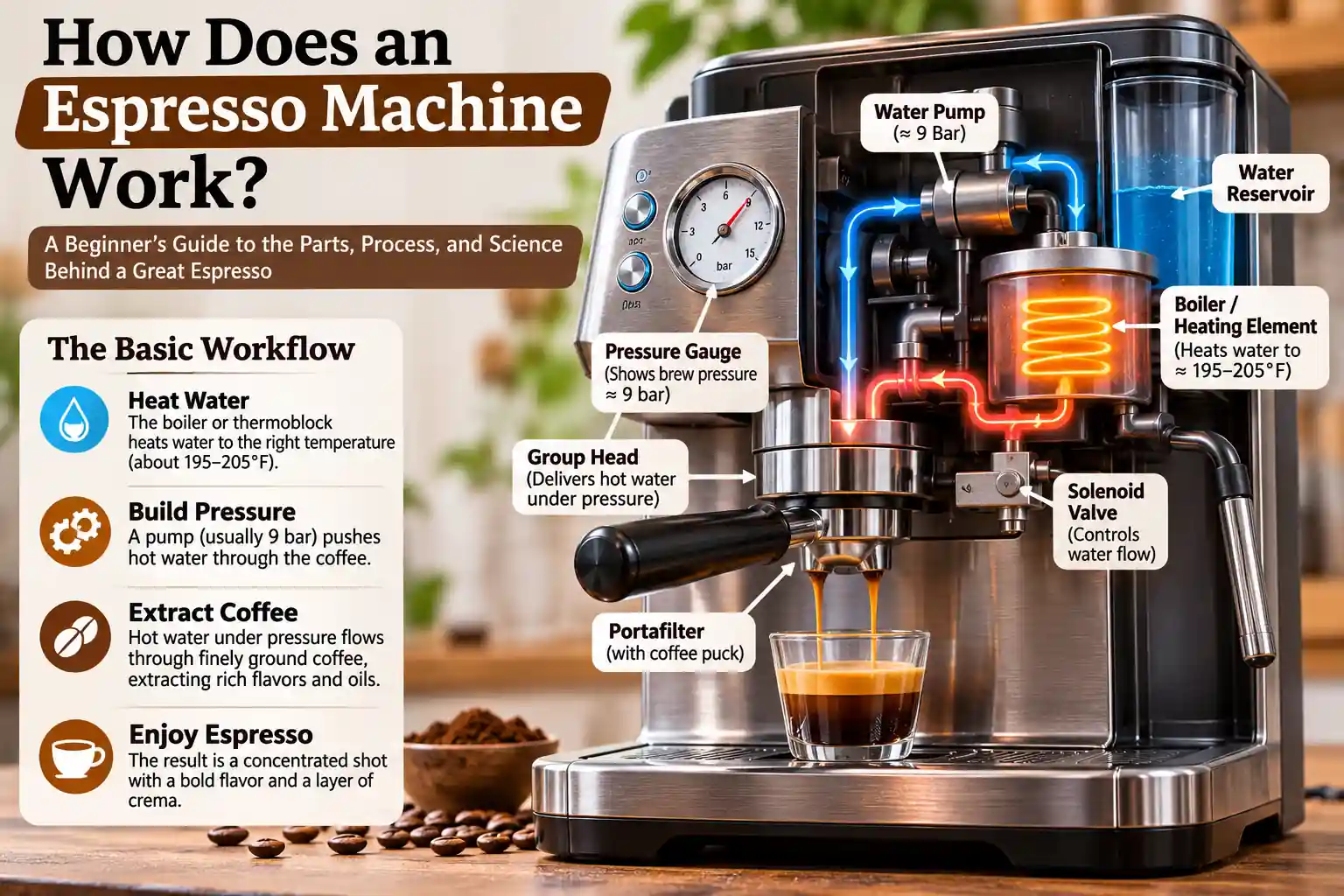 →
How Does an Espresso Machine Work? Complete Guide
How Does an Espresso Machine Work? A Complete Beginner's Guide An espresso machine transforms finely ground coffee beans and hot water into a concentrated coffee drink known as espresso. Unlike traditional drip coffee…
· 26 min read
 →
How to Descale a Breville Espresso Machine (Step-by-Step Guide)
How to Descale a Breville Espresso Machine: A Complete Step-by-Step Guide Knowing how to descale a Breville espresso machine is essential for maintaining consistent coffee quality, protecting internal components, and…
· 20 min read
 →
How to Clean a Breville Espresso Machine (Step-by-Step Guide)
What You Need Before Cleaning a Breville Espresso Machine Before cleaning your machine, gather the necessary supplies. Having everything ready makes the process easier and reduces the risk of damaging sensitive…
· 24 min read