
How to Clean a DeLonghi Espresso Machine (Step-by-Step Guide)
How to Clean a DeLonghi Espresso Machine: A Complete Step-by-Step Guide Aclean espresso machine is essential for making fresh, flavorful coffee and keeping your equipment in excellent working condition. Whether you own…
By Menu Moments
Menu Moments editorial
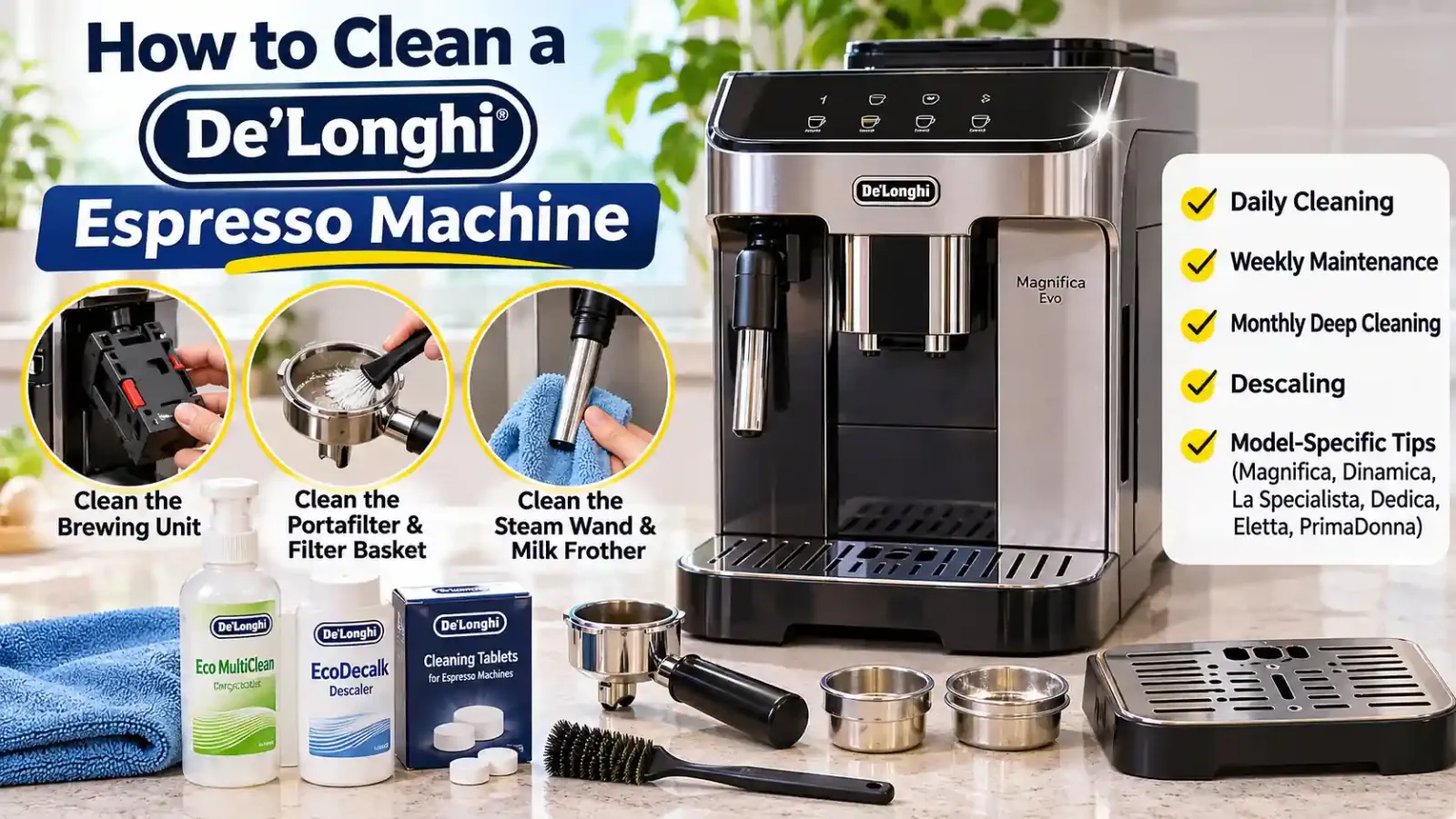
How to Clean a DeLonghi Espresso Machine: A Complete Step-by-Step Guide
Aclean espresso machine is essential for making fresh, flavorful coffee and keeping your equipment in excellent working condition. Whether you own a De’Longhi Magnifica, Magnifica Evo, Dinamica, La Specialista, Dedica, Eletta, or PrimaDonna, regular cleaning helps remove coffee residue, prevent mineral buildup, maintain consistent espresso extraction, and extend your machine's lifespan.
If you are wondering how to clean a DeLonghi espresso machine, the process is relatively simple once you understand which components need daily attention, which parts require weekly cleaning, and when to perform a deeper monthly maintenance routine.
DeLonghi coffee machine cleaning involves more than wiping the exterior. Coffee oils accumulate inside the brewing system, milk residue can collect in the frothing system, and minerals from hard water gradually create limescale buildup. These problems can affect coffee quality, cause slow espresso extraction, produce poor crema, and eventually interfere with machine performance.
This beginner-friendly guide explains how to clean different DeLonghi espresso machine models, remove coffee buildup, clean removable components, maintain the milk frother, and perform descaling safely. You will also learn which cleaning products to use, common cleaning mistakes to avoid, and how often to maintain your machine.
Why Is It Important to Clean a DeLonghi Espresso Machine?
A DeLonghi espresso machine handles water, coffee grounds, heat, and sometimes milk every time you prepare a drink. These ingredients leave behind deposits that can affect the taste of your espresso and the operation of internal components.
Regular cleaning improves coffee machine hygiene and helps prevent several common problems.
Remove Coffee Residue and Coffee Oils
Coffee residue and coffee oils accumulate around the brew group, portafilter, filter basket, coffee spouts, and coffee outlet. Over time, these deposits can become stale and affect the flavor of freshly brewed espresso.
If you notice a bitter coffee taste, unpleasant smell, or inconsistent extraction, dirty internal components may be contributing to the problem.
Prevent Limescale Buildup
Water contains minerals, including calcium and magnesium. When heated repeatedly, these minerals can accumulate inside the heating system and water pathways.
This creates limescale buildup, which may cause:
Slow water flow.
Unusual machine noises.
Temperature inconsistencies.
Reduced brewing performance.
Frequent descaling warnings.
Using a suitable water filter and following the recommended descaling schedule can help minimize these problems.
Maintain Milk Frothing Performance
Milk residue can collect inside the milk frother, steam wand, steam nozzle, milk carafe, and LatteCrema system.
If these components are not cleaned properly, dried milk can block the frothing system, affect milk texture, and create unpleasant odors.
Extend Your Espresso Machine Lifespan
Regular maintenance protects important components and reduces unnecessary strain on the machine.
Cleaning also helps preserve coffee quality, maintain consistent performance, and extend the espresso machine lifespan.
What You Need to Clean a DeLonghi Espresso Machine
Before starting, gather the appropriate cleaning supplies. Most routine cleaning tasks require basic household materials and manufacturer-approved cleaning products.
Cleaning Supply | Purpose |
|---|---|
Microfiber cloth | Wiping the exterior and removing coffee stains |
Soft cleaning brush | Removing loose coffee grounds and residue |
Warm water | Washing removable components |
Mild detergent | Cleaning compatible removable accessories |
DeLonghi Eco MultiClean | Cleaning milk system components |
DeLonghi EcoDecalk | Removing limescale buildup |
Espresso machine cleaning tablets | Cleaning compatible brewing systems |
Grinder cleaning brush | Removing coffee particles from accessible grinder areas |
Understanding DeLonghi Cleaning Products
Two useful products from DeLonghi are Eco MultiClean and EcoDecalk.
DeLonghi Eco MultiClean: This cleaning solution is designed for compatible milk system components and helps remove milk residue from surfaces and accessories.
DeLonghi EcoDecalk: This descaling solution helps dissolve mineral deposits inside the water circuit.
Espresso machine cleaning tablets may also be suitable for certain models, but you should check the user manual before using them. Not every DeLonghi machine supports cleaning tablets or backflushing.
Important: Never assume that every cleaning product is compatible with every DeLonghi model. Follow the De’Longhi official cleaning instructions and use the model-specific cleaning procedure.
How to Clean a DeLonghi Espresso Machine Step by Step
The cleaning process depends on whether you own a manual espresso machine, a fully automatic coffee maker, or a model with an integrated milk system.
However, the following general steps cover the most important cleaning tasks.
Step 1: Turn Off and Unplug the Machine
Before cleaning removable components, turn off the machine and allow hot surfaces to cool.
Unplug the appliance before performing manual cleaning around accessible internal areas.
Never immerse the main machine body, electrical components, or power cord in water.
Step 2: Remove and Empty the Drip Tray
The drip tray collects excess water, coffee spills, and liquid produced during rinsing cycles.
To clean it:
Carefully slide the drip tray out of the machine.
Remove the drip tray grille if it is detachable.
Empty all accumulated water.
Wash compatible parts using warm water and mild detergent.
Use a soft brush to remove stubborn coffee stains.
Rinse thoroughly and dry the components.
Reassemble the tray after everything is dry.
Clean the Drip Tray Grille
The drip tray grille can develop coffee stains and mineral deposits.
Remove it according to your model's instructions and clean both sides. Check whether the grille is dishwasher-safe before placing it in a dishwasher.
Step 3: Empty the Coffee Grounds Container
Fully automatic DeLonghi machines collect used coffee grounds in a removable container.
These compressed portions of used coffee are commonly called a coffee puck.
To clean the container:
Remove the drip tray and grounds container.
Empty all used coffee pucks.
Wash the container with warm water and mild detergent.
Remove any stuck coffee residue.
Rinse and dry thoroughly.
Reinstall the container.
Emptying the coffee grounds container regularly helps prevent unpleasant odors and reduces the risk of mold developing in damp coffee residue.
Some models require the machine to be switched on when removing or emptying the grounds container. Follow your user manual to avoid triggering incorrect notifications.
Step 4: Clean the Water Tank
The water tank stores the water used for brewing espresso and rinsing internal components.
A dirty reservoir can affect water freshness and overall coffee machine hygiene.
Follow these steps:
Remove the water tank.
Empty any remaining water.
Wash the reservoir with warm water.
Use a small amount of mild detergent if permitted.
Rinse thoroughly to remove detergent residue.
Allow it to air-dry or dry with a clean cloth.
Refill with fresh drinking water.
If your machine has a water filter, check its replacement schedule and installation instructions.
Check the Water Filter
A compatible water filter can reduce certain minerals and impurities in the water supply.
However, a water filter does not eliminate the need for descaling. Follow the manufacturer's guidance for filter replacement and water hardness settings.
Step 5: Clean the Brewing Unit or Removable Infuser
Cleaning DeLonghi brewing unit components is particularly important for fully automatic machines.
The removable infuser, also known as the brew group, handles the coffee grounds during the brewing process.
Coffee residue can accumulate around the infuser, affecting extraction and leaving stale coffee oils inside the machine.
To clean it:
Switch off the machine using its power button.
Wait until the machine has completed its shutdown cycle.
Open the service door according to the model instructions.
Remove the removable infuser if your model allows it.
Rinse it under lukewarm running water.
Gently remove loose coffee particles.
Allow it to dry completely.
Reinstall it according to the manufacturer's instructions.
How to Remove and Clean Infuser Components
Some DeLonghi models have a removable infuser that can be accessed behind a service panel.
Never force the brew group out of its housing. If it does not release easily, consult the user manual and follow the machine's positioning instructions.
Should You Use Soap on the Infuser?
For many DeLonghi removable infusers, the recommended approach is rinsing with water without detergent.
Avoid using harsh chemicals, abrasive brushes, or excessive force. Also, do not place the infuser in a dishwasher unless your specific model explicitly permits it.
Step 6: Clean the Coffee Spouts and Coffee Outlet
Coffee spouts can become clogged with dried coffee residue and oils.
A blocked coffee spout may cause uneven dispensing, dripping, or inconsistent coffee flow.
To clean the coffee outlet:
Inspect the coffee dispensing area.
Wipe the exterior using a damp microfiber cloth.
Use a soft cleaning brush to remove accessible loose coffee grounds.
Follow the manual's instructions for cleaning the internal outlet.
Run a rinse cycle if recommended.
Avoid inserting sharp objects into the coffee outlet because they may damage internal components.
Step 7: Clean the Pre-Ground Coffee Funnel
If your DeLonghi machine supports pre-ground coffee, it may include a separate pre-ground coffee funnel.
Coffee powder can accumulate inside this opening and eventually create blockages.
Open the appropriate compartment and remove loose powder using a dry, soft cleaning brush.
Do not pour water directly into the pre-ground coffee funnel.
Step 8: Clean the Coffee Grinder
Fully automatic DeLonghi machines commonly include a coffee grinder that processes whole beans before brewing.
A burr grinder uses rotating grinding surfaces to produce coffee particles of a suitable size.
Coffee particles and stale coffee oils can accumulate around accessible grinder areas.
Use the following approach:
Remove accessible loose coffee grounds.
Clean the accessible area with a grinder cleaning brush.
Follow the user manual for grinder-specific maintenance.
Never pour water into the grinder.
Avoid disassembling internal grinder components unless the manufacturer specifically provides instructions.
A clean grinder helps maintain consistent grinding performance and fresh espresso flavor.
How to Clean the Milk Frother and Steam Wand
If you regularly prepare cappuccinos, lattes, or other milk-based drinks, cleaning the milk frother is essential.
Milk contains proteins and fats that can stick to internal surfaces. When these deposits dry, they become difficult to remove and may block the milk delivery system.
Step 9: Clean the DeLonghi Steam Wand
Manual DeLonghi espresso machines often include a steam wand for heating and frothing milk.
To clean the steam wand:
Wipe the steam wand immediately after preparing a milk-based drink.
Use a damp microfiber cloth to remove milk residue.
Briefly activate the steam function according to your model's instructions to clear remaining milk from the nozzle.
Turn off the steam function.
Allow the wand to cool.
Remove and clean the steam nozzle if your model permits it.
Check for dried milk around the nozzle openings.
How to Clean a DeLonghi Steam Nozzle
The steam nozzle can become blocked when milk dries inside its openings.
If the nozzle is removable, follow the user manual to detach it and rinse it with warm water. Use an appropriate cleaning brush to remove accessible residue.
Never force a sharp object into the steam openings.
Step 10: Clean the DeLonghi Milk Frother
The milk frother requires regular cleaning because milk residue can collect inside its components.
For removable milk frothing accessories:
Detach compatible components.
Rinse them with warm water.
Use a suitable cleaning solution when recommended.
Remove visible milk residue.
Rinse away all cleaning solution.
Allow components to dry before reassembling.
Cleaning the LatteCrema System
Some DeLonghi machines feature the LatteCrema system, an integrated milk frothing technology designed to produce textured milk foam.
Depending on the model, the system may include a milk carafe, milk container, milk intake tube, and adjustable frothing components.
After preparing milk-based drinks:
Return the milk carafe to the machine if required.
Activate the automatic cleaning cycle using the milk system's cleaning control.
Allow the machine to flush the milk pathways.
Remove the milk carafe when appropriate.
Clean removable components according to the manual.
Store the milk container as directed by the manufacturer.
Step 11: Clean the Milk Carafe and Milk Container
Milk carafes can develop dried milk deposits, particularly around the lid, intake tube, and dispensing nozzle.
To clean a removable milk carafe:
Remove it from the espresso machine.
Disassemble the removable components.
Empty any remaining milk.
Rinse each compatible component.
Wash using warm water and an appropriate cleaning product.
Use DeLonghi Eco MultiClean if recommended for your model.
Rinse thoroughly.
Dry or store the components according to the manufacturer's instructions.
How to Prevent Milk Residue and Mold
Never leave milk inside the milk container for extended periods.
Refrigerate milk according to food safety recommendations and clean the milk-contact components regularly. Proper cleaning helps prevent mold, unpleasant smells, and bacterial growth.
Step 12: Run the Automatic Cleaning Cycle
Many DeLonghi machines include an automatic cleaning cycle that flushes water through internal coffee or milk pathways.
The exact process varies by model.
Some machines automatically rinse their internal coffee circuits when switched on or off. Others provide dedicated cleaning controls for the milk system.
Follow the displayed instructions rather than assuming every model uses the same procedure.
An automatic cleaning cycle is useful for removing loose coffee residue, but it does not replace manual cleaning of removable components or periodic descaling.
How to Clean Different DeLonghi Espresso Machine Models
DeLonghi manufactures several espresso machine families, including manual, semi-automatic, and fully automatic models.
Although many cleaning principles are similar, their removable components and maintenance procedures can differ.
How to Clean DeLonghi Magnifica
The DeLonghi Magnifica is a fully automatic espresso machine family that generally includes an integrated grinder and removable brewing components.
For routine cleaning:
Empty the coffee grounds container.
Clean the drip tray.
Wash the water tank.
Remove and rinse the removable infuser when supported.
Clean the coffee outlet.
Brush accessible coffee grounds from the grinder area.
Run the recommended rinsing and descaling procedures.
Check the specific Magnifica model because older and newer versions may have different maintenance instructions.
How to Clean DeLonghi Magnifica Evo
The Magnifica Evo is another popular fully automatic machine with different versions and milk preparation options.
Its cleaning routine generally includes:
Emptying the grounds container.
Cleaning the drip tray.
Washing the water reservoir.
Cleaning the removable brewing unit when applicable.
Wiping the coffee dispensing area.
Cleaning the milk carafe and milk delivery components on compatible versions.
Following the machine's descaling notifications.
If your Magnifica Evo has a LatteCrema system, use its dedicated milk-cleaning function after preparing milk-based drinks.
How to Clean DeLonghi Dinamica
The DeLonghi Dinamica family includes automatic espresso machines with integrated coffee preparation features.
For regular maintenance, clean the drip tray, coffee grounds container, water tank, and removable infuser.
If your Dinamica includes a milk carafe, clean its milk-contact components after use.
Use the machine's automatic rinsing and descaling functions as indicated by its display.
How to Clean DeLonghi La Specialista
The DeLonghi La Specialista is a semi-automatic espresso machine family that combines manual espresso preparation with integrated grinding and other brewing features.
Unlike fully automatic machines, cleaning often focuses on the portafilter, filter basket, grinder area, tamping station, and steam wand.
Cleaning the Portafilter and Filter Basket
Remove the portafilter after brewing.
Discard the coffee puck.
Remove the filter basket if detachable.
Rinse both components with warm water.
Remove coffee oils and residue using an appropriate cleaning product.
Dry before reassembling.
Cleaning the Tamping and Grinder Areas
Brush away loose coffee grounds from accessible surfaces.
Use a grinder cleaning brush around the bean outlet and accessible grinding areas. Avoid pouring water into the burr grinder.
Cleaning the Steam Wand
Wipe the steam wand immediately after frothing milk, then purge it according to the manufacturer's instructions.
How to Clean DeLonghi Dedica
The DeLonghi Dedica is a compact manual espresso machine.
Its cleaning routine is relatively straightforward because it generally has fewer automatic components than a fully automatic Magnifica or Dinamica.
Focus on these components:
Portafilter.
Filter basket.
Drip tray.
Drip tray grille.
Water tank.
Coffee outlet.
Steam wand.
Steam nozzle.
Remove the used coffee puck after each brewing session. Rinse the portafilter and filter basket, and clean the steam wand immediately after preparing milk.
Check your Dedica model's manual for its recommended descaling and filter-cleaning procedures.
How to Clean DeLonghi Eletta
DeLonghi Eletta machines are fully automatic coffee makers with advanced beverage preparation and milk system options.
Their maintenance routine may include:
Cleaning the removable infuser.
Emptying the grounds container.
Washing the drip tray.
Cleaning coffee dispensing outlets.
Maintaining the milk carafe.
Running automatic milk-cleaning cycles.
Descaling when prompted.
For models equipped with LatteCrema technology, pay particular attention to the milk container and dispensing components.
How to Clean DeLonghi PrimaDonna
PrimaDonna models offer automatic coffee preparation and, depending on the version, integrated milk systems.
Follow the cleaning notifications displayed by your machine.
Regularly clean the drip tray, grounds container, water tank, brewing unit, coffee outlet, and milk system.
For models with removable infusers, rinse the brewing unit as directed in the user manual.
Important: Cleaning instructions can differ between individual model numbers within the same product family. Always check your exact model before removing components or using cleaning products.
How to Descale a DeLonghi Espresso Machine
Cleaning and descaling are two different maintenance tasks.
Cleaning removes coffee grounds, coffee oils, milk residue, and other surface deposits. Descaling removes mineral deposits that accumulate inside the water circuit.
If you use hard water, descaling becomes particularly important.
What Causes Limescale Buildup?
Hard water contains dissolved minerals that can accumulate inside heating elements, pipes, and other water-contact components.
As water is repeatedly heated, mineral deposits may gradually restrict water flow.
A water hardness test can help determine how frequently your machine needs descaling.
When Should You Descale Your DeLonghi Machine?
Your machine may display a descaling light or a maintenance notification when descaling is required.
The frequency depends on:
Water hardness.
Daily coffee consumption.
Water filter usage.
Machine model.
Manufacturer maintenance recommendations.
Do not ignore a descaling notification, even if your machine appears to be working normally.
Step-by-Step Descaling Process
The exact descaling procedure depends on your DeLonghi model, but many machines follow a similar process.
Prepare the recommended DeLonghi EcoDecalk solution according to the product instructions.
Empty the water tank.
Add the descaling solution and the required amount of water.
Position a suitable container beneath the coffee and hot-water outlets.
Activate the machine's descaling program.
Allow the machine to dispense the solution through its water circuit.
Empty the collection container when instructed.
Rinse the water tank thoroughly.
Refill it with fresh water.
Complete the machine's rinse cycle.
Repeat the rinsing process if instructed by the display.
Always follow the quantities, sequence, and safety instructions specified in your model's manual.
For a more detailed explanation of mineral removal and maintenance, read our guide on how to descale an espresso machine.
Can You Clean a DeLonghi Espresso Machine Without Vinegar?
Yes. In fact, using a manufacturer-approved descaling product is generally preferable to experimenting with household vinegar.
Vinegar is not the recommended descaling solution for many DeLonghi machines. It may leave a strong odor, affect certain materials, or fail to follow the manufacturer's specified maintenance procedure.
Use EcoDecalk or another descaler explicitly approved for your model.
For routine cleaning, warm water, a microfiber cloth, and compatible cleaning products are usually sufficient.
Should You Use Espresso Machine Cleaning Tablets?
Espresso machine cleaning tablets are designed to help remove coffee oils and residue from compatible brewing systems.
However, not every DeLonghi espresso machine uses cleaning tablets.
Some fully automatic machines have removable infusers that are cleaned by rinsing with water. Certain manual machines may support specific cleaning procedures involving compatible tablets.
When Are Cleaning Tablets Appropriate?
Use cleaning tablets only when your particular model's user manual recommends them.
Never put a cleaning tablet into the pre-ground coffee funnel or water tank unless the manufacturer's instructions explicitly direct you to do so.
What Is Backflushing?
Backflushing is a cleaning method used on compatible espresso machines with a three-way solenoid valve.
It forces water and, when appropriate, a cleaning product backward through the group head to remove accumulated coffee oils.
Not all DeLonghi espresso machines support backflushing.
Do not assume that a manual or automatic DeLonghi machine can be backflushed. Check the manufacturer instructions before attempting this procedure.
How Often Should You Clean a DeLonghi Espresso Machine?
A consistent machine maintenance schedule makes cleaning easier and helps prevent stubborn buildup.
The ideal frequency depends on how frequently you make espresso, whether you prepare milk-based drinks, and your local water quality.
Here is a practical maintenance schedule to follow, subject to your model's instructions.
Cleaning Task | Recommended Frequency |
|---|---|
Wipe coffee spills | After each use |
Clean the steam wand | After every milk drink |
Empty coffee grounds container | Daily or when prompted |
Empty and rinse drip tray | Daily or when needed |
Rinse portafilter and filter basket | After each brewing session |
Clean milk-contact components | After use, following model instructions |
Clean water tank | Regularly, preferably daily |
Clean removable infuser | Approximately weekly or as directed |
Inspect coffee grinder | Weekly |
Deeper component cleaning | Monthly |
Descale the water circuit | When prompted or according to water hardness |
Daily Espresso Machine Cleaning
Daily espresso machine cleaning helps prevent fresh coffee residue and milk deposits from becoming difficult to remove.
Make these tasks part of your daily routine:
Wipe the machine's exterior.
Empty the coffee grounds container.
Clean the drip tray.
Rinse the portafilter and filter basket.
Clean the steam wand.
Rinse compatible milk system components.
Check the water tank.
Weekly Coffee Machine Maintenance
Weekly coffee machine maintenance focuses on components that collect residue over several brewing sessions.
Clean the removable infuser when applicable, inspect the coffee spouts, remove accessible coffee grounds, and check the water tank and drip tray.
Also inspect the milk frother for dried deposits or blockages.
Monthly Espresso Machine Cleaning
Monthly espresso machine cleaning provides an opportunity to inspect components that may not need attention every day.
Depending on the machine, this can include:
A more thorough cleaning of removable components.
Inspecting the coffee grinder.
Checking the water filter.
Cleaning accessible coffee outlets.
Inspecting the milk delivery system.
Reviewing the descaling status.
Checking the machine's overall performance.
Monthly cleaning does not mean that you should descale every month. Descaling frequency should be determined by water hardness, machine notifications, and manufacturer recommendations.
Common DeLonghi Espresso Machine Cleaning Problems and Solutions
Even with regular maintenance, you may occasionally experience problems caused by coffee buildup, mineral deposits, or blocked components.
Understanding these issues can help you troubleshoot a dirty DeLonghi machine before minor problems become more serious.
Why Does My DeLonghi Espresso Machine Make Bitter Coffee?
A bitter coffee taste can result from several factors, including stale coffee oils, old coffee grounds, excessive extraction, or dirty brewing components.
Try these solutions:
Clean the removable infuser.
Rinse the portafilter and filter basket.
Remove accumulated coffee residue.
Clean the coffee spouts.
Use fresh coffee beans.
Check your grinder settings.
If bitterness continues, investigate the coffee beans, water temperature, and extraction settings as well.
Why Is My DeLonghi Espresso Machine Brewing Slowly?
Slow espresso extraction may indicate a clogged coffee filter, blocked coffee spout, mineral deposits, or an excessively fine grind.
To troubleshoot:
Inspect the filter basket for blockage.
Clean the coffee outlet.
Remove visible coffee residue.
Check the water tank and water filter.
Descale the machine if indicated.
Review your coffee grinder settings.
If water flow remains restricted, consult an authorized service technician.
Why Is My DeLonghi Machine Producing Poor Crema?
Poor crema can be caused by stale beans, incorrect grinding, unsuitable extraction settings, or accumulated coffee oils.
Cleaning the brewing unit and coffee outlet can help, but remember that crema also depends on coffee freshness, roast, grind size, and brewing pressure.
Why Is the Coffee Coming Out of Only One Spout?
A blocked coffee spout may prevent espresso from dispensing evenly.
Clean the accessible dispensing openings using a soft cleaning brush and follow the manufacturer's instructions for flushing the coffee outlet.
Avoid using needles or other sharp objects that could damage the dispensing components.
Why Does My DeLonghi Milk Frother Stop Working?
Milk residue can block the milk intake tube, steam nozzle, or other parts of the frothing system.
Remove compatible components, clean them thoroughly, and run the recommended milk-cleaning cycle.
If the problem continues, check the milk system's assembly and consult the user manual.
Common DeLonghi Espresso Machine Cleaning Mistakes to Avoid
Cleaning your espresso machine incorrectly can cause damage or reduce its performance.
Avoid these common cleaning mistakes.
1. Using Vinegar Without Checking the Manual
Many users assume vinegar is suitable for every coffee machine. However, DeLonghi recommends its own descaling solution for many models.
Choose a compatible cleaning solution rather than experimenting with household chemicals.
2. Using Abrasive Cleaning Materials
Steel wool, abrasive sponges, and harsh brushes can scratch plastic, stainless steel, and other surfaces.
Use a microfiber cloth and soft cleaning brush instead.
3. Washing Electrical Components
Never immerse the espresso machine body, power cord, or electrical components in water.
Clean the exterior with a slightly damp cloth.
4. Ignoring the Milk Frother
Milk residue can dry quickly and become difficult to remove.
Always clean the steam wand and milk-contact components immediately after preparing milk-based beverages.
5. Forgetting the Coffee Grounds Container
Leaving used coffee grounds inside the machine for extended periods can encourage unpleasant odors and mold growth.
Empty the container regularly and clean it according to the manufacturer's instructions.
6. Using the Wrong Cleaning Tablets
Some espresso machines support cleaning tablets, while others require different maintenance procedures.
Using incompatible products or placing tablets in the wrong compartment can cause problems.
Always check the model-specific cleaning procedure.
7. Removing the Infuser Incorrectly
Never force the removable infuser out of its housing.
Follow the machine's shutdown and positioning instructions before attempting to remove the brew group.
8. Skipping the Rinse Cycle
After using a cleaning product or descaler, complete all required rinsing steps.
Residual cleaning solution can affect the taste of your coffee and should not remain in the water circuit.
Tips to Keep Your DeLonghi Espresso Machine Clean for Longer
Good cleaning habits can reduce maintenance time and help your machine deliver consistent coffee.
Consider these practical tips:
Use fresh, filtered drinking water when appropriate.
Follow the recommended water hardness settings.
Empty the drip tray regularly.
Remove used coffee grounds before they accumulate.
Clean the steam wand immediately after milk preparation.
Keep the coffee grinder area free of loose grounds.
Use compatible cleaning products.
Replace the water filter according to the manufacturer's schedule.
Pay attention to descaling notifications.
Keep the exterior clean with a microfiber cloth.
Follow the recommended cleaning and maintenance schedule.
If you are still learning espresso preparation, our guide on how to use an espresso machine explains the basic brewing process, equipment, and preparation techniques.
You can also explore our general guide on how to clean an espresso machine for additional cleaning advice covering different espresso machine types.
Frequently Asked Questions About Cleaning a DeLonghi Espresso Machine
How Do You Clean a DeLonghi Espresso Machine?
Turn off the machine, empty the drip tray and coffee grounds container, wash the water tank, clean the removable infuser if applicable, and remove coffee residue from accessible components. Clean the milk frother and steam wand after use. Descale the machine when its notification or maintenance schedule indicates that it is necessary.
How Often Should I Clean My DeLonghi Espresso Machine?
You should perform basic cleaning daily, rinse milk-contact components after use, and inspect removable brewing components regularly. A more thorough monthly inspection is also useful. Descaling should follow the machine's notifications and water hardness recommendations.
Can I Use Dish Soap to Clean My DeLonghi Espresso Machine?
You can use a small amount of mild detergent on compatible removable components when the user manual permits it. However, avoid applying dish soap to the internal brewing system, electrical components, or parts that require water-only cleaning.
Can I Put DeLonghi Removable Parts in the Dishwasher?
Not all removable components are dishwasher-safe. Some drip trays, grilles, and milk system parts may have different cleaning requirements. Check the user manual for your exact model before using a dishwasher.
Can I Use Vinegar to Descale My DeLonghi Espresso Machine?
It is generally better to use DeLonghi EcoDecalk or another manufacturer-approved descaler. Vinegar is not the recommended solution for many DeLonghi models and may leave unwanted odors or affect certain components.
How Do I Clean a DeLonghi Coffee Maker?
To clean a DeLonghi coffee maker, remove and wash compatible removable components, empty the drip tray and coffee grounds container, rinse the water tank, and clean the brewing system according to the model's instructions. If your machine has a milk frother, clean it after preparing milk-based drinks.
How Do I Clean DeLonghi Espresso Machine Coffee Filters?
Remove the filter basket from the portafilter if possible. Rinse it under warm water and remove trapped coffee grounds using a soft brush. For stubborn coffee oils, use a compatible espresso machine cleaning product if recommended by the manufacturer.
How Do I Clean Coffee Buildup Inside My DeLonghi Machine?
Start by cleaning accessible brewing components, the removable infuser, coffee outlet, and grounds container. Use the recommended cleaning cycle for internal coffee pathways. If mineral buildup is suspected, follow the machine's descaling procedure.
How Do I Prevent Mold in My DeLonghi Espresso Machine?
Empty the coffee grounds container regularly, avoid leaving standing water in dirty drip trays, clean milk-contact components after use, and allow compatible removable parts to dry properly. Regular maintenance helps prevent mold and unpleasant odors.
Do I Need to Clean My DeLonghi Espresso Machine After Every Use?
You do not need to perform a complete deep cleaning after every espresso. However, you should remove used coffee grounds, rinse the portafilter and filter basket, wipe coffee spills, and clean the steam wand or milk system after preparing milk-based drinks.
Does a DeLonghi Espresso Machine Clean Itself?
Many DeLonghi machines automatically rinse internal coffee pathways when switched on or off. Some models also offer automatic milk-cleaning programs. However, these features do not replace manual cleaning of removable components, regular maintenance, or descaling.
What Is the Difference Between Cleaning and Descaling?
Cleaning removes coffee grounds, coffee oils, and milk residue from accessible components and brewing pathways. Descaling removes mineral deposits, particularly limescale, from the internal water circuit.
Both procedures are important for maintaining your espresso machine.
Can a Dirty Espresso Machine Affect Coffee Quality?
Yes. Coffee residue, stale coffee oils, mineral buildup, and milk deposits can affect coffee flavor, extraction consistency, and overall machine performance. Regular cleaning helps maintain fresh espresso and consistent brewing results.
Final Thoughts
Learning how to clean a DeLonghi espresso machine is an important part of maintaining your coffee equipment and enjoying better espresso at home.
Whether you own a Magnifica, Magnifica Evo, Dinamica, La Specialista, Dedica, Eletta, or PrimaDonna, the most important maintenance tasks include cleaning the brewing unit, emptying the coffee grounds container, washing the drip tray, maintaining the water tank, and removing milk residue from the frothing system.
Make daily cleaning a habit, perform weekly coffee machine maintenance, and inspect your machine monthly. Use DeLonghi Eco MultiClean and EcoDecalk when appropriate, follow the recommended rinse cycle, and never ignore descaling notifications.
With the correct cleaning products and a consistent maintenance schedule, you can protect your espresso machine, improve coffee machine hygiene, and enjoy fresh espresso for years.
If you are considering upgrading your coffee setup, explore our guide to the best espresso machines under $500 for affordable options.
Enjoyed this tip?
A weekly hit of kitchen know-how.
Tips, techniques and small upgrades — every Sunday.
Keep reading
You might also like
7 Best Espresso Machines Under $500 (2026 Buying Guide)
Discover the best espresso machine under $500. Compare Breville, Gaggia, De'Longhi, and CASABREWS models by price, features, pros, and cons.
· 34 min read
 →
How to Make Coffee with an Espresso Machine
How to Make Coffee with an Espresso Machine: A Complete Beginner's Guide Learning how to make coffee with an espresso machine is easier than many beginners expect. Whether you own a manual espresso machine,…
· 22 min read
 →
How to Descale an Espresso Machine
How to Descale an Espresso Machine: A Complete Step-by-Step Guide Descaling an espresso machine is an essential part of keeping your coffee equipment clean, efficient, and working properly. Over time, minerals from…
· 19 min read