
How Does an Espresso Machine Work? Complete Guide
How Does an Espresso Machine Work? A Complete Beginner's Guide An espresso machine transforms finely ground coffee beans and hot water into a concentrated coffee drink known as espresso. Unlike traditional drip coffee…
By Menu Moments
Menu Moments editorial
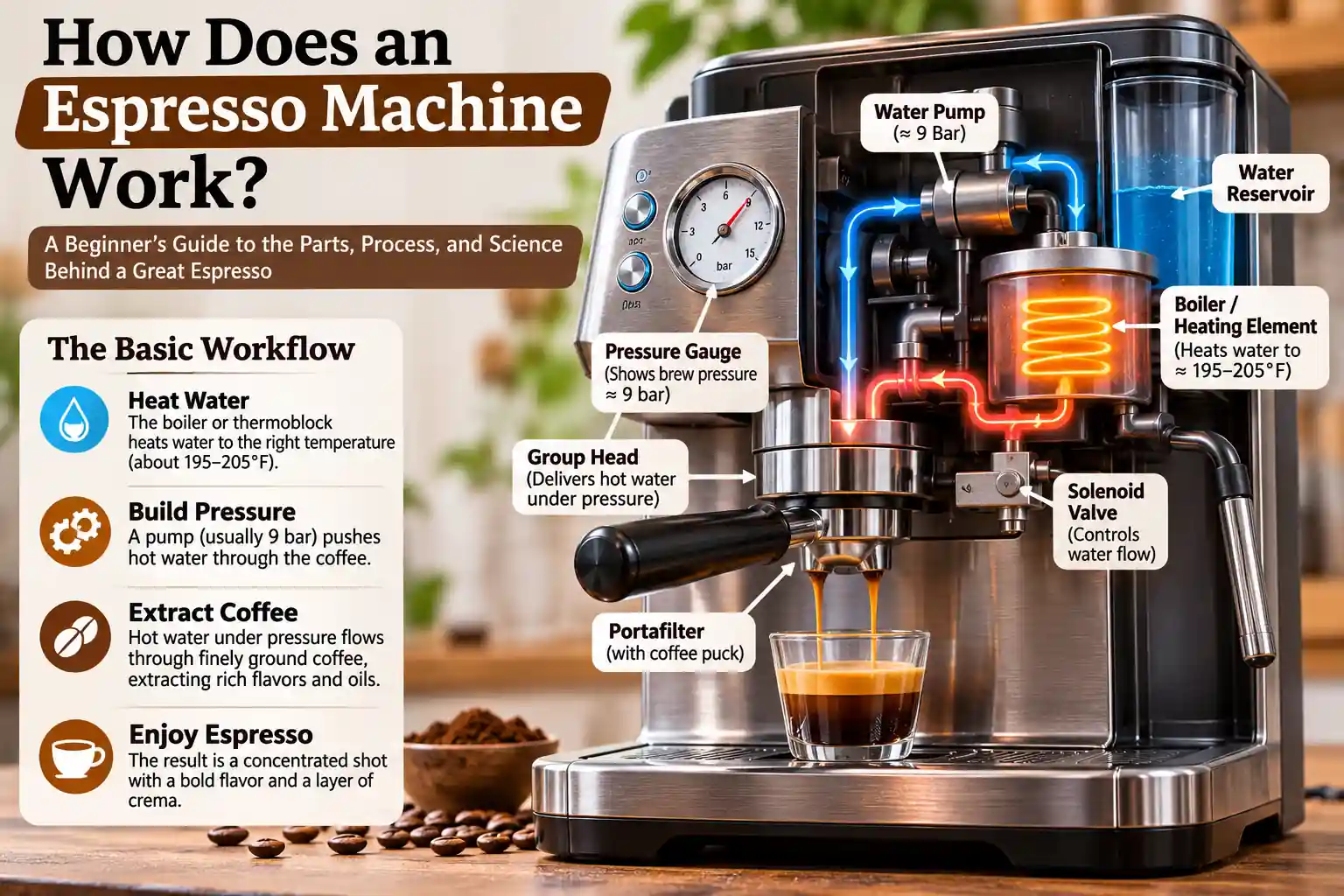
How Does an Espresso Machine Work? A Complete Beginner's Guide
An espresso machine transforms finely ground coffee beans and hot water into a concentrated coffee drink known as espresso. Unlike traditional drip coffee makers, which rely primarily on gravity, an espresso machine uses controlled water temperature and high pressure to extract flavor, aroma, oils, and other compounds from coffee grounds in a relatively short amount of time.
Understanding how does an espresso machine work can help you make better coffee, choose the right machine, troubleshoot brewing problems, and get more consistent results at home. Although espresso machines come in different designs, most modern models follow the same basic principle: heat water, generate pressure, distribute hot water through a prepared coffee puck, and collect the resulting espresso shot.
Behind every espresso shot is a combination of mechanical and electrical components working together. These include a water reservoir, water pump, boiler or heating system, group head, portafilter, filter basket, pressure controls, and temperature regulation systems.
Whether you own a basic home espresso machine, a semi-automatic model, or a professional commercial espresso machine, understanding its internal mechanism makes the brewing process easier to manage.
In this guide, we will explain the espresso machine working principle, explore its main components, break down the complete espresso extraction process, and discuss the differences between various machine types.
What Is the Working Principle of an Espresso Machine?
The espresso machine working principle involves forcing heated water through finely ground coffee at controlled pressure. This process extracts soluble compounds, aromatic oils, and other flavor components from the coffee grounds to produce a concentrated beverage.
Most modern pump-driven espresso machines use approximately 9 bar pressure at the coffee puck during extraction. This pressure helps hot water move through tightly packed coffee grounds, producing the rich texture and concentrated flavor associated with espresso.
The process involves four fundamental operations:
Water heating: The machine heats water to an appropriate brewing temperature.
Pressure generation: A pump or mechanical lever creates the pressure needed for extraction.
Coffee extraction: Pressurized hot water passes through the coffee puck.
Espresso collection: The extracted coffee flows through the portafilter spouts or directly into a cup.
Unlike a drip coffee maker, an espresso machine does not simply pour water over coffee. It controls several brewing variables, including water temperature, extraction pressure, water flow, and extraction time.
Why Does Espresso Require Pressure?
Pressure is essential because espresso uses finely ground coffee packed tightly into a filter basket.
Without sufficient pressure, water would struggle to pass through the coffee puck at the desired flow rate. The pump provides the force needed to move water through the coffee grounds and extract a concentrated beverage.
The commonly referenced 9 bar pressure is a traditional espresso brewing target. However, actual extraction pressure can vary depending on the machine, coffee, and brewing profile.
Pressure also influences how water interacts with the coffee particles, affecting extraction speed, flavor balance, and crema formation.
How Is Espresso Different From Regular Coffee?
Espresso is more concentrated than most traditionally brewed coffee because it uses a smaller quantity of water relative to the amount of coffee.
The main differences include:
Brewing pressure: Espresso uses pressure to push water through finely ground coffee.
Grind size: Espresso generally requires a much finer grind than drip coffee.
Brewing time: An espresso shot typically extracts in approximately 25–35 seconds, depending on the recipe.
Coffee concentration: Espresso contains a higher concentration of dissolved coffee compounds.
Texture: Espresso often develops a layer of crema containing emulsified coffee oils and gas bubbles.
These characteristics make espresso suitable as a base for drinks such as cappuccinos, Americanos, macchiatos, and lattes.
Main Espresso Machine Components and Their Functions
To understand espresso machine mechanics, it helps to examine the individual components that work together during brewing.
Although the design varies between manufacturers, most espresso machine parts perform similar functions.
1. Water Reservoir
<escape>The</escape> water reservoir stores the water used for brewing and steaming.
In many home espresso machines, the reservoir is a removable plastic container located at the back or side of the machine. Some commercial models connect directly to a water supply.
When the machine starts brewing, water moves from the reservoir toward the pump.
The reservoir should contain fresh, filtered water suitable for espresso brewing. Water quality affects flavor and can influence mineral buildup inside the machine.
2. Water Pump
The water pump creates the pressure needed to move water through the coffee puck.
Most modern pump-driven espresso machines use either a vibratory pump or a rotary pump.
Vibratory Pump
A vibratory pump uses an electromagnetic mechanism to move a small piston back and forth. This movement pushes water through the machine and generates brewing pressure.
Its advantages include:
Relatively affordable construction.
Compact size.
Simple installation.
Suitable performance for most home espresso machines.
Vibratory pumps are common in entry-level and mid-range home espresso machines.
Rotary Pump
A rotary pump uses a rotating mechanism to move water through the machine.
Compared with vibratory pumps, rotary pumps are generally quieter and can provide smoother, more consistent operation.
They are frequently found in premium home machines and commercial espresso equipment.
How Does an Espresso Machine Create Pressure?
When the brewing cycle begins, the pump pushes water through the internal plumbing toward the group head.
The resistance created by the compressed coffee puck allows pressure to build during extraction.
The machine regulates this process through its pump design and pressure-control components.
3. Boiler or Heating System
The heating system raises the water temperature to the level required for brewing.
Different espresso machines use different heating technologies, including traditional boilers, thermoblock heating systems, and thermocoils.
Single Boiler
A single boiler uses one heated water chamber for both espresso brewing and steam production.
The machine generally needs to switch between brewing temperature and a higher steam temperature.
This design is relatively affordable and suitable for beginners who do not frequently prepare multiple milk-based drinks.
Dual Boiler System
A dual boiler system uses two separate boilers.
One boiler maintains the brewing temperature, while the other produces steam.
This arrangement allows users to brew espresso and steam milk simultaneously without waiting for the machine to change temperatures.
Dual boiler machines are popular among serious home baristas and commercial users who prioritize workflow and temperature stability.
Thermoblock Heating System
A thermoblock heating system heats water as it flows through a heated metal channel or block.
Instead of storing a large volume of hot water, it raises the temperature of water when needed.
Benefits include:
Fast heating.
Compact construction.
Reduced water storage.
Relatively affordable manufacturing.
However, temperature stability depends on the thermoblock design, water flow, and machine controls.
Thermocoil
A thermocoil is another heating technology that uses a metal coil or heated water pathway to warm water during circulation.
Some manufacturers use thermocoils to improve heating response and provide controlled water delivery.
The exact design varies between espresso machine models.
4. Group Head
The group head is the section where hot water enters the coffee basket during extraction.
It connects the machine's internal water system to the portafilter.
The group head helps distribute water toward the coffee puck and maintain a stable brewing environment.
Some professional machines feature heated group heads to improve temperature stability.
5. Portafilter
The portafilter is a handle-equipped metal holder that contains the filter basket.
The barista fills it with ground coffee, distributes the grounds, and tamps them before locking it into the group head.
Most portafilters have a metal handle and a removable basket.
Common designs include:
Single-spout portafilters.
Double-spout portafilters.
Bottomless portafilters.
6. Filter Basket
The filter basket sits inside the portafilter and holds the coffee grounds during brewing.
It contains small holes through which extracted espresso flows.
Filter baskets come in different sizes and capacities, allowing users to prepare different coffee doses.
A single basket is generally designed for a smaller coffee dose, while a double basket accommodates a larger dose.
7. Coffee Tamper
A tamper is a tool used to compress coffee grounds inside the filter basket.
This process is known as tamping.
Proper tamping creates a relatively even coffee puck, helping water flow through the grounds consistently.
The goal is not to apply as much force as possible. Instead, the coffee should be distributed evenly and compressed level with the basket.
8. Shower Screen and Dispersion Screen
The shower screen is located inside the group head.
It helps distribute incoming water across the surface of the coffee puck.
A dispersion screen is a related term used for components designed to spread water more evenly before it reaches the coffee grounds.
These components help reduce uneven water distribution and improve extraction consistency.
9. Pressure Gauge
A pressure gauge displays pressure inside a particular section of the espresso machine.
Depending on the machine, it may show pump pressure, boiler pressure, or brewing pressure.
Some machines include a dedicated brew pressure gauge, while others display only boiler pressure.
A pressure gauge can help users identify whether the machine is operating within its intended pressure range.
10. Solenoid Valve
A solenoid valve is an electrically controlled valve that directs water through different sections of the machine.
It opens or closes depending on the brewing cycle.
Many espresso machines use a three-way solenoid valve.
Three-Way Solenoid Valve
A three-way solenoid valve controls water movement during and after brewing.
When extraction stops, it can release excess pressure from the group head and direct remaining water toward the drain.
This helps reduce pressure inside the portafilter and makes removing the portafilter safer and easier.
11. Steam Wand
The steam wand produces steam used to heat and texture milk.
It receives high-temperature steam from the steam boiler or heating system.
When steam enters cold milk, it creates a combination of heat and air incorporation that produces microfoam.
A properly textured milk surface is important for preparing cappuccinos, lattes, and other espresso-based beverages.
12. Hot Water Outlet
Some espresso machines include a separate hot water outlet.
It supplies hot water for Americanos, tea, and other beverages.
On many commercial machines, the hot water outlet is connected to the boiler system.
13. Pressure Relief Valve and Overpressure Valve
Espresso machines use pressure-control mechanisms to prevent excessive pressure from developing inside the system.
An overpressure valve, commonly called an OPV, helps limit pump pressure by redirecting excess water.
A pressure relief valve serves a related safety purpose by releasing pressure when it exceeds a specified limit.
The exact arrangement depends on the machine's engineering.
How Does an Espresso Machine Work Step by Step?
Now that you understand the major components, let's examine the complete espresso machine brewing cycle.
The espresso machine workflow begins when water enters the heating system and ends when the finished espresso reaches your cup.
Step 1: Water Enters the Machine
The process begins with the water reservoir or connected water supply.
When the machine is switched on, its internal system makes water available to the pump.
The water reservoir supplies the water needed for brewing, while internal tubing directs it toward the heating system.
This initial stage is part of espresso machine water circulation.
Step 2: The Machine Heats the Water
The heating element raises the water temperature to the appropriate brewing level.
Many espresso machines operate within a brewing temperature range of approximately 195–205°F (90–96°C).
The ideal temperature depends on the coffee beans, roast level, and brewing recipe.
The machine's espresso machine temperature control system helps maintain the required temperature.
Some machines use PID temperature control to regulate heating more precisely.
What Is PID Temperature Control?
PID stands for Proportional-Integral-Derivative.
It is a control system that continuously adjusts heating output based on the difference between the measured water temperature and the target temperature.
A PID controller can help improve temperature stability and reduce temperature fluctuations during brewing.
Consistent water temperature is important because temperature influences how quickly different compounds dissolve from coffee grounds.
Step 3: The Pump Generates Pressure
Once the machine is ready, the pump begins moving water toward the group head.
In a pump-driven machine, the vibratory pump or rotary pump creates the force needed to move water through the brewing system.
The pump's pressure is regulated according to the machine's design.
During traditional espresso extraction, the target is commonly around 9 bar at the coffee puck.
This is the stage that explains how a pump-driven espresso machine works.
Step 4: Water Reaches the Group Head
The heated water travels through internal pipes and enters the group head.
The shower screen distributes the water across the coffee puck.
This stage is important because uneven water distribution can lead to inconsistent extraction.
Some espresso machines use pre-infusion before reaching full brewing pressure.
What Is Pre-Infusion?
Pre-infusion is the process of gently wetting coffee grounds before applying full extraction pressure.
It allows water to penetrate the coffee puck more evenly.
Depending on the machine, pre-infusion may use lower pressure, a slower water flow, or a brief pause before full pressure develops.
Pre-infusion can help reduce channeling and improve extraction consistency.
Step 5: Hot Water Passes Through the Coffee Puck
Before brewing, the barista places finely ground coffee into the filter basket.
The grounds are distributed evenly and compressed using a tamper.
This creates the coffee puck.
When hot water under pressure reaches the coffee puck, it moves through the tiny spaces between the coffee particles.
During this process, water dissolves soluble compounds and carries aromatic substances and coffee oils into the cup.
This is the central stage of how an espresso machine extracts coffee.
Step 6: Espresso Extraction Takes Place
The espresso extraction process involves several variables:
Coffee dose.
Grind size.
Brew ratio.
Water temperature.
Extraction pressure.
Extraction time.
Water flow.
These variables determine the final flavor and strength of the espresso.
For example, a common starting recipe uses 18 grams of ground coffee to produce approximately 36 grams of espresso.
This represents a 1:2 brew ratio.
However, different coffees may require different recipes.
Step 7: Crema Forms
As espresso flows into the cup, a golden or reddish-brown foam layer may develop on its surface.
This is called espresso crema.
Crema formation occurs partly because carbon dioxide released from roasted coffee becomes trapped in tiny bubbles as pressure decreases.
Coffee oils and other compounds contribute to its texture and appearance.
Although crema is a familiar characteristic of espresso, its thickness alone does not determine whether a shot tastes good.
Step 8: The Brewing Cycle Ends
Once the desired coffee yield is reached, the machine stops the brewing process.
The three-way solenoid valve may release remaining pressure from the group head.
The used coffee puck can then be removed from the portafilter.
The machine is ready for another brewing cycle after the basket and portafilter are cleaned.
How Does an Espresso Machine Heat Water?
Water heating is one of the most important aspects of espresso machine mechanics.
The machine needs to heat water quickly while maintaining a relatively stable temperature during extraction.
The method depends on the heating technology.
Traditional Boiler Heating
A boiler stores water inside a heated chamber.
An internal heating element raises the water temperature, while thermostats or electronic controls regulate heating.
A traditional boiler can maintain a supply of hot water for brewing or steaming.
Thermoblock Heating
A thermoblock heats water as it moves through an internal heated pathway.
This approach reduces the need to store a large amount of hot water.
It is commonly used in compact home espresso machines.
How Does the Machine Maintain Temperature?
Temperature stability depends on several factors:
Heating element performance.
Boiler or thermoblock capacity.
Temperature sensors.
Electronic temperature controls.
Water flow during brewing.
Group head temperature.
Machines equipped with PID temperature control generally offer more precise electronic temperature regulation.
However, a well-designed traditional thermostat system can also produce excellent espresso.
How Does an Espresso Machine Create and Control Pressure?
Pressure is one of the defining characteristics of espresso brewing.
The water pump supplies pressure, while the coffee puck creates resistance against the incoming water.
The machine's pressure-control components help regulate this process.
Understanding 9 Bar Pressure
Nine bar pressure is a widely used reference point for traditional espresso extraction.
One bar is approximately equal to atmospheric pressure at sea level.
Nine bar is approximately 130.5 PSI.
However, the pressure displayed on a machine's gauge may not always represent the exact pressure at the coffee puck.
Pressure can differ depending on the location of the gauge, pump characteristics, and machine configuration.
What Is Pressure Profiling?
Pressure profiling means changing extraction pressure during different stages of brewing.
Rather than maintaining one constant pressure, some machines allow the user to adjust pressure throughout the espresso shot.
For example, a brewing profile may include:
Gentle initial pressure.
Gradual pressure increase.
Main extraction.
Reduced pressure toward the end.
Pressure profiling gives experienced users greater control over water movement and extraction characteristics.
It can be particularly useful when experimenting with different coffee beans.
Understanding the Espresso Extraction Process
The espresso extraction process determines how much flavor and soluble material move from coffee grounds into the finished drink.
A balanced espresso should have a pleasant combination of sweetness, acidity, bitterness, aroma, and body.
The result depends on the relationship between grind size, coffee dose, water temperature, brew ratio, and extraction time.
Coffee Dose
Coffee dose refers to the amount of ground coffee placed inside the filter basket.
A typical double espresso recipe might use 18 grams of coffee, although basket sizes and brewing preferences vary.
Coffee Yield
Coffee yield is the weight of the espresso produced during extraction.
For example, 18 grams of ground coffee producing 36 grams of espresso creates a 1:2 brew ratio.
Brew Ratio
The brew ratio compares the weight of dry coffee grounds with the weight of the finished espresso.
Common starting points include:
| Brew ratio | Example | General result |
|---|---|---|
| 1:1 | 18g coffee, 18g espresso | Short, concentrated shot |
| 1:2 | 18g coffee, 36g espresso | Traditional balanced starting point |
| 1:3 | 18g coffee, 54g espresso | Longer, more diluted extraction |
These are starting points rather than strict rules.
Extraction Time
Extraction time measures how long water flows through the coffee puck.
Many traditional espresso recipes begin with approximately 25–35 seconds.
However, the correct extraction time depends on the coffee, grind size, machine, and desired flavor.
Grind Size Adjustment
Grind size is one of the most important variables affecting extraction.
Finer grounds generally increase resistance and slow water flow.
Coarser grounds generally reduce resistance and allow faster water flow.
If the espresso runs too quickly, grinding finer may help.
If it runs too slowly, grinding coarser may improve the result.
The goal is to achieve a balanced extraction rather than simply following a fixed time.
What Happens Inside Different Types of Espresso Machines?
Not every espresso machine uses the same internal mechanism.
Some machines rely on electric pumps, while others use mechanical levers.
Understanding these differences helps explain how different espresso machine designs operate.
Manual Espresso Machine
A manual espresso machine requires the user to control most aspects of brewing.
Depending on the design, the user may manually control water delivery, pressure, or extraction.
These machines provide significant control but require more skill and practice.
Lever Espresso Machine
A lever espresso machine uses a mechanical lever to generate brewing pressure.
The user pulls or operates the lever to move water through the coffee puck.
How Does a Lever Espresso Machine Work?
In a spring-operated lever machine, pulling the lever compresses a spring and allows water to enter the brewing chamber.
Releasing the lever allows the spring to push a piston downward, forcing water through the coffee grounds.
In a direct-lever design, the user manually controls piston movement and pressure.
Lever machines can provide a distinctive extraction profile, but they require practice to operate consistently.
Semi-Automatic Espresso Machine
A semi-automatic espresso machine uses an electric pump to generate brewing pressure.
The user controls important steps, including:
Grinding coffee.
Preparing the coffee puck.
Starting extraction.
Stopping extraction.
Steaming milk.
This is one of the most popular machine types for home espresso enthusiasts.
Automatic Espresso Machine
An automatic espresso machine uses programmed controls to manage the brewing cycle.
The user typically selects a brewing button or preset.
The machine controls water delivery and automatically stops extraction according to its programming.
Super-Automatic Espresso Machine
A super-automatic espresso machine automates much of the coffee-making process.
Many models include:
Built-in coffee grinders.
Automatic dosing.
Coffee tamping mechanisms.
Automatic brewing.
Programmable coffee settings.
Integrated milk systems.
Some models also include automatic cleaning functions.
These machines are convenient for users who want espresso with minimal manual preparation.
Commercial Espresso Machine
A commercial espresso machine is designed for frequent use in coffee shops, restaurants, and other professional environments.
It generally features more powerful heating systems, larger boilers, multiple group heads, and higher-capacity water systems.
Commercial machines are built to support repeated brewing and milk steaming throughout busy service periods.
Home Espresso Machine
A home espresso machine is designed for personal use.
These machines are usually more compact and may feature smaller boilers, thermoblocks, or thermocoils.
They are available in manual, semi-automatic, automatic, and super-automatic designs.
Heat Exchanger Espresso Machine
A heat exchanger espresso machine uses a single boiler to maintain steam temperature while a separate internal pathway heats brewing water.
This allows users to brew espresso and steam milk simultaneously.
Heat exchanger machines are particularly popular among home enthusiasts who want the convenience of simultaneous brewing and steaming without purchasing a dual boiler model.
What Happens During the Espresso Machine Brewing Cycle?
The espresso machine brewing cycle follows a sequence of mechanical and thermal operations.
Here is a simplified overview:
| Brewing stage | What happens | Main component |
|---|---|---|
| Water supply | Water enters the machine | Water reservoir |
| Heating | Water reaches brewing temperature | Boiler or thermoblock |
| Pressure generation | Water pressure increases | Water pump |
| Pre-infusion | Coffee grounds become evenly wet | Group head |
| Extraction | Hot water passes through coffee | Portafilter and filter basket |
| Pressure release | Remaining pressure is released | Solenoid valve |
| Collection | Espresso reaches the cup | Portafilter spouts |
Understanding this workflow makes it easier to identify potential problems and improve brewing consistency.
Espresso Machine vs. Drip Coffee Maker
An espresso machine and a drip coffee maker both use hot water to extract flavor from ground coffee, but their brewing methods are different.
| Feature | Espresso machine | Drip coffee maker |
|---|---|---|
| Brewing method | Pressurized extraction | Gravity-based extraction |
| Coffee grind | Fine | Medium |
| Brewing pressure | Typically around 9 bar at the puck | No comparable pump pressure |
| Extraction time | Usually shorter | Generally longer |
| Coffee concentration | Higher | Lower |
| Crema | Can produce crema | Does not produce traditional espresso crema |
| Equipment | More complex | Generally simpler |
An espresso machine is ideal for concentrated coffee and espresso-based beverages.
A drip coffee maker is more convenient for preparing larger quantities of regular coffee.
Espresso Machine vs. Moka Pot
A moka pot is a stovetop coffee maker that uses steam pressure generated by heated water.
Although moka pots produce concentrated coffee, they do not operate in the same way as traditional espresso machines.
| Feature | Espresso machine | Moka pot |
|---|---|---|
| Pressure source | Electric pump or mechanical lever | Steam pressure |
| Typical pressure | Around 9 bar at the puck | Much lower |
| Brewing method | Pressurized extraction | Stovetop pressure brewing |
| Grind size | Fine espresso grind | Medium-fine grind |
| Crema | Can produce traditional espresso crema | Does not produce typical espresso crema |
| Power | Electricity or mechanical operation | Stovetop heat |
A moka pot is generally more affordable and portable, while an espresso machine offers greater control over brewing pressure and temperature.
Espresso Machine vs. Coffee Maker: Which Is Better?
The choice between an espresso machine and a regular coffee maker depends on your preferences.
An espresso machine is better suited to people who enjoy concentrated coffee and want to prepare drinks such as cappuccinos, lattes, and Americanos.
A standard coffee maker is a better choice for people who prefer larger servings and straightforward brewing.
Consider an espresso machine if you want:
Strong, concentrated coffee.
Espresso-based milk drinks.
More control over brewing variables.
A traditional espresso-making experience.
Choose a regular coffee maker if you prefer:
Simple operation.
Larger batches of coffee.
Less preparation.
Minimal equipment maintenance.
If you are shopping for a home model, explore our guide to the best espresso machines under $500 for affordable options.
Common Espresso Extraction Problems and How to Fix Them
Even a well-designed espresso machine can produce inconsistent results if the coffee is not prepared correctly.
Understanding common espresso extraction problems can help you troubleshoot brewing issues.
1. Under-Extraction
Under-extraction occurs when too few desirable soluble compounds are extracted from the coffee.
Common symptoms include:
Sour or sharp flavor.
Thin body.
Weak sweetness.
Watery texture.
Possible solutions:
Grind the coffee finer.
Increase extraction time.
Check brewing temperature.
Adjust the brew ratio.
Improve coffee puck preparation.
2. Over-Extraction
Over-extraction occurs when excessive extraction produces an unpleasant flavor profile.
Common symptoms include:
Harsh bitterness.
Dry mouthfeel.
Astringency.
Unbalanced flavor.
Possible solutions:
Grind slightly coarser.
Reduce extraction time.
Adjust the coffee dose.
Experiment with a shorter brew ratio.
Not all bitterness indicates over-extraction, so consider the coffee's roast level and natural flavor characteristics too.
3. Channeling
Channeling occurs when water finds easier pathways through the coffee puck rather than flowing evenly through the entire bed.
This can cause uneven extraction.
Common causes include:
Uneven coffee distribution.
Poor tamping technique.
Clumps in finely ground coffee.
Incorrect grind size.
An unevenly prepared coffee puck.
How to prevent channeling:
Distribute coffee grounds evenly.
Break up visible clumps.
Use a suitable tamper.
Tamp level.
Avoid disturbing the coffee puck before brewing.
4. Espresso Runs Too Quickly
If espresso flows too quickly, the grind may be too coarse or the coffee dose may be too low.
Try grinding finer and checking the amount of coffee in the basket.
5. Espresso Runs Too Slowly
If water struggles to pass through the coffee puck, the grind may be too fine or the basket may be overfilled.
Try grinding slightly coarser and checking the coffee dose.
6. Weak or No Pressure
If the machine cannot build sufficient pressure, possible causes include:
Incorrect grind size.
Insufficient coffee dose.
Water supply problems.
A clogged filter basket.
Pump malfunction.
Internal leaks.
Pressure-control issues.
Check the water reservoir and filter basket before assuming the pump is damaged.
How to Maintain an Espresso Machine
Regular espresso machine maintenance helps protect internal components, maintain brewing performance, and improve coffee flavor.
Coffee oils, mineral deposits, and leftover grounds can accumulate over time.
A proper maintenance routine should include daily cleaning and periodic deeper maintenance.
Daily Espresso Machine Cleaning
After each brewing session:
Remove the portafilter.
Discard the used coffee puck.
Rinse the filter basket.
Flush the group head.
Wipe the shower screen.
Clean the steam wand immediately after steaming milk.
Empty and rinse the drip tray.
These simple steps help prevent coffee residue from accumulating inside the machine.
Backflushing
Backflushing is a cleaning process used with espresso machines that support this feature.
It involves placing a blind basket into the portafilter and using a suitable espresso machine cleaning product according to the manufacturer's instructions.
The process helps remove accumulated coffee oils and residue from the group head and internal brewing pathways.
Not every espresso machine supports backflushing, so always check the manufacturer's instructions.
Descaling
Descaling removes mineral deposits that build up inside the machine due to water hardness.
Mineral buildup can restrict water flow, reduce heating efficiency, and interfere with temperature stability.
Descaling frequency depends on water quality, machine design, and manufacturer recommendations.
Use an appropriate descaling product rather than household chemicals.
Cleaning the Group Head
The group head should be cleaned regularly to remove coffee residue.
Use a suitable cleaning brush to clean around the gasket and shower screen.
If the shower screen is removable, follow the manufacturer's instructions for cleaning it.
When Should You Service Your Espresso Machine?
Professional servicing may be necessary when the machine develops persistent problems such as:
Unusual pump noise.
Water leakage.
Inconsistent brewing temperature.
Pressure fluctuations.
Electrical faults.
Persistent water flow restrictions.
For a complete maintenance routine, see our guides on how to clean an espresso machine and how to descale an espresso machine.
Factors That Affect Espresso Machine Performance
Several factors determine how effectively an espresso machine operates.
Water Quality
Water contains minerals that influence coffee extraction and internal machine maintenance.
Extremely hard water can cause mineral buildup, while unsuitable water chemistry may negatively affect flavor.
Use water that meets the espresso machine manufacturer's recommendations.
Coffee Bean Freshness
Freshly roasted coffee generally produces more aromatic espresso.
Coffee beans lose volatile aromatic compounds over time, which can influence flavor and crema formation.
Coffee Grind Consistency
A consistent grind helps water flow more evenly through the coffee puck.
A quality burr grinder is particularly useful for espresso because it allows precise grind size adjustment.
Brewing Temperature
Water temperature affects the rate at which soluble coffee compounds are extracted.
Temperature fluctuations can create inconsistent results, particularly when preparing multiple espresso shots.
Pump Performance
The pump must supply adequate water pressure and flow for the machine to operate correctly.
A worn or malfunctioning pump may lead to weak extraction or inconsistent brewing.
Regular Maintenance
A clean machine is more likely to deliver consistent results.
Cleaning the group head, shower screen, filter basket, and steam wand helps prevent residue buildup.
Tips for Getting Better Espresso From Your Machine
You do not need expensive equipment or professional barista training to make good espresso at home.
A few basic practices can significantly improve your results.
Use freshly ground coffee: Grind beans shortly before brewing to preserve aroma.
Choose the correct grind size: Start with a fine espresso grind and adjust according to extraction speed.
Measure your coffee dose: Use a digital scale for consistent preparation.
Distribute coffee evenly: Avoid creating gaps or uneven areas inside the filter basket.
Tamp level: A level coffee puck helps encourage even water flow.
Monitor extraction time: Use timing as a guide rather than an absolute rule.
Measure coffee yield: Keep your brew ratio consistent when experimenting.
Maintain temperature stability: Allow the machine to warm up according to its instructions.
Keep equipment clean: Remove coffee oils and residue regularly.
Experiment gradually: Change one brewing variable at a time so you can understand its effect.
Frequently Asked Questions About How Espresso Machines Work
1. How does an espresso machine work in simple terms?
An espresso machine heats water and uses a pump or mechanical lever to force it through finely ground coffee at high pressure. The water extracts flavor compounds and coffee oils, producing a concentrated espresso shot.
2. Why do espresso machines use 9 bar pressure?
Approximately 9 bar is a traditional espresso extraction target. It provides sufficient pressure to move hot water through a tightly packed coffee puck and produce concentrated espresso.
However, different machines and brewing profiles may use different pressure settings.
3. How hot does an espresso machine get?
Many espresso machines maintain brewing water temperatures between approximately 195°F and 205°F (90°C and 96°C). Steam systems operate at higher temperatures.
The exact temperature depends on the machine and its settings.
4. Does an espresso machine boil water?
Not necessarily. Espresso brewing generally requires water below its boiling point.
The boiler or heating system heats water to the desired brewing temperature. Steam production requires a higher temperature than ordinary espresso extraction.
5. What does the pump do in an espresso machine?
The pump moves water through the machine and generates the pressure needed for extraction. Common designs include vibratory pumps and rotary pumps.
6. What is the difference between a single boiler and a dual boiler espresso machine?
A single boiler uses one boiler for both brewing and steam production, requiring temperature changes between operations.
A dual boiler system uses separate boilers for brewing and steaming, allowing both processes to happen simultaneously.
7. What is a group head on an espresso machine?
The group head is the part of the machine where hot water enters the portafilter and flows toward the coffee puck.
It plays an important role in water distribution and brewing temperature stability.
8. What is pre-infusion in espresso brewing?
Pre-infusion is the process of gently introducing water to the coffee puck before full extraction pressure is applied.
It helps wet the coffee grounds and can improve extraction consistency.
9. Why does espresso have crema?
Crema forms when gases, particularly carbon dioxide from roasted coffee, become trapped in tiny bubbles as espresso exits the pressurized brewing environment.
Coffee oils and other compounds contribute to its appearance and texture.
10. How long does an espresso machine take to make coffee?
Once fully heated and prepared, many machines can extract an espresso shot in approximately 25–35 seconds.
However, preparation, grinding, heating, and cleanup add to the overall time.
11. Can an espresso machine make regular coffee?
An espresso machine can produce espresso-based drinks such as Americanos by combining espresso with hot water.
However, it does not automatically brew regular drip coffee in the same way as a traditional coffee maker.
12. What happens if espresso machine pressure is too high?
Excessive pressure may result in uneven extraction, channeling, and an unbalanced flavor profile.
Machines with an OPV help regulate pressure and protect the brewing system.
13. Can I use regular ground coffee in an espresso machine?
Regular pre-ground coffee may be too coarse for espresso machines.
For better results, use coffee ground specifically for espresso or a grinder that allows fine adjustments.
14. How often should an espresso machine be cleaned?
Basic cleaning should happen after every brewing session. Backflushing and descaling should be performed according to the machine's design, water quality, and manufacturer's maintenance schedule.
15. What is the difference between espresso and regular coffee?
Espresso is produced by forcing hot water through finely ground coffee under pressure. Regular drip coffee typically uses gravity to move water through a bed of coarser coffee grounds.
Espresso is generally more concentrated and has a different texture.
Final Thoughts
Understanding how an espresso machine works makes it easier to prepare better coffee and troubleshoot common brewing problems.
At its core, an espresso machine combines water heating, pressure generation, controlled water flow, and coffee extraction. Components such as the boiler, water pump, group head, portafilter, filter basket, and solenoid valve work together to transform ground coffee into a concentrated espresso shot.
Whether you use a manual espresso machine, semi-automatic model, automatic machine, or commercial espresso machine, the basic extraction principle remains similar.
For beginners, the most important things to understand are grind size, coffee dose, water temperature, extraction pressure, and brew ratio. Once you become comfortable with these variables, you can experiment with different coffee beans and brewing techniques to develop your preferred espresso flavor.
Regular cleaning, descaling, and proper machine maintenance will also help keep your equipment working efficiently and producing consistent espresso for years to come.
Enjoyed this?
A recipe, a tip and a link worth clicking — every Sunday.
Free. Weekly. Unsubscribe anytime.
Keep reading
You might also like
 →
How to Clean an Espresso Machine: Step-by-Step Guide
How to Clean an Espresso Machine: Step-by-Step Guide Cleaning your espresso machine regularly is essential for making great-tasting coffee, maintaining consistent espresso extraction, and extending the life of your…
· 23 min read
 →
How to Make Coffee with an Espresso Machine
How to Make Coffee with an Espresso Machine: A Complete Beginner's Guide Learning how to make coffee with an espresso machine is easier than many beginners expect. Whether you own a manual espresso machine,…
· 22 min read
7 Best Espresso Machines Under $500 (2026 Buying Guide)
Discover the best espresso machine under $500. Compare Breville, Gaggia, De'Longhi, and CASABREWS models by price, features, pros, and cons.
· 34 min read