
Microwave Wattage Explained: 700 vs 900 vs 1,000 Watts (Cooking Time Chart)
What microwave wattage means, how to find yours, and how to adjust package cooking times for a 700, 800, 900, 1,000 or 1,200-watt microwave, with a ready-made chart.
Disclosure: Menu Moments earns a commission on qualifying purchases through some of the links below. Read the full policy →
Advertisement
A microwave’s wattage tells you how much cooking power it has. The higher the wattage, the faster it heats. That matters every time you follow the directions on a frozen meal or a recipe: the times are written for a particular wattage, and a lower-powered microwave needs longer.
Quick answer: most full-size microwaves are 1,000 to 1,200 watts and compact models 600 to 800 watts. To convert a cooking time, multiply it by the wattage on the package and divide by your microwave’s wattage. Food that takes 3 minutes at 1,100 watts needs about 4:45 at 700 watts.
How to Find Your Microwave’s Wattage
- Look for the label inside the door frame, on the back or on the bottom. It usually lists the output (cooking) power in watts.
- Check the manual or search the model number online.
- Do the water test if there is no label: heat 1 cup (8 oz) of cold tap water on high and time how long it takes to boil. Roughly: under 2 minutes means 1,000 watts or more, 2 to 2½ minutes about 900, 2½ to 3 minutes about 700 to 800, and longer than 3 minutes under 700.
Input vs output watts: the label may show two numbers. The higher one (for example 1,500 W) is the power the microwave draws from the outlet; the lower one is its cooking power. Use the cooking power when adjusting times.
Advertisement
Cooking Time Conversion Chart
Many packaged-food directions are written for a 1,100-watt microwave; check your package, as some say 1,000 or 1,200. This chart converts times written for 1,100 watts:
| Package time (1,100 W) | 700 W | 800 W | 900 W | 1,000 W | 1,200 W |
|---|---|---|---|---|---|
| 1 min | 1:35 | 1:25 | 1:15 | 1:05 | 0:55 |
| 2 min | 3:10 | 2:45 | 2:25 | 2:10 | 1:50 |
| 3 min | 4:45 | 4:10 | 3:40 | 3:20 | 2:45 |
| 4 min | 6:15 | 5:30 | 4:55 | 4:25 | 3:40 |
| 5 min | 7:50 | 6:55 | 6:05 | 5:30 | 4:35 |
| 6 min | 9:25 | 8:15 | 7:20 | 6:35 | 5:30 |
| 8 min | 12:35 | 11:00 | 9:45 | 8:50 | 7:20 |
| 10 min | 15:45 | 13:45 | 12:15 | 11:00 | 9:10 |
Times are rounded to the nearest 5 seconds. Start with the converted time, stir or turn the food, and add 15 to 30 seconds at a time if it needs more.
The Formula
Your time = package time × package wattage ÷ your wattage.
Example: a frozen meal says 4 minutes at 1,100 watts and your microwave is 900 watts. 4 × 1,100 ÷ 900 = about 4.9 minutes, so set it for 4 minutes 50 seconds.
What Power Levels Mean
On most microwaves, the power level is a percentage of full power: level 10 is 100%, level 5 is 50%. At lower levels the microwave cycles on and off, which heats food more gently.
| Power level | Share of full power | Good for |
|---|---|---|
| 10 (High) | 100% | Boiling water, vegetables, most reheating |
| 7 to 8 | 70 to 80% | Reheating dense leftovers and casseroles evenly |
| 5 | 50% | Simmering, softening, cooking delicate foods |
| 3 | 30% | Defrosting |
| 1 to 2 | 10 to 20% | Keeping food warm, softening butter |
700 vs 900 vs 1,000 Watts: Which Should You Buy?
- 700 watts suits a dorm, office or second microwave: compact and affordable, but slower, and package times need adjusting.
- 900 watts is a good middle ground for apartments: close to full speed in a smaller cabinet.
- 1,000 watts or more is best for a family’s main microwave: it matches most package directions and heats evenly.

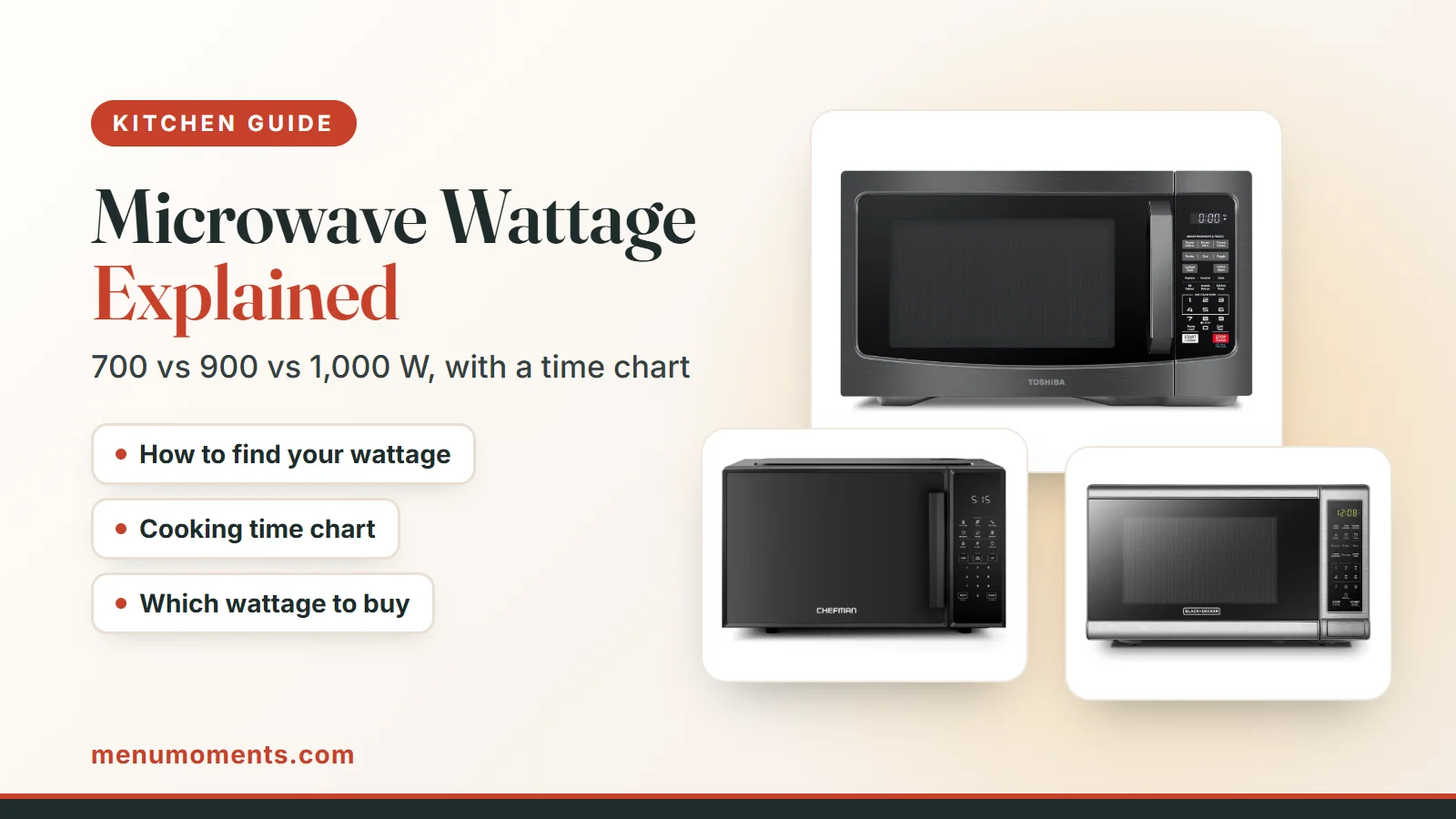
Toshiba EM131A5C-BS 1.2 Cu Ft Microwave
Full-size with a smart humidity sensor, a 12.4-inch turntable, ECO mode and mute.
Check price on Amazon
Chefman 0.9 Cu Ft 900-Watt Microwave
Near full-size speed in a smaller cabinet, with ECO mode and mute.
Check price on Amazon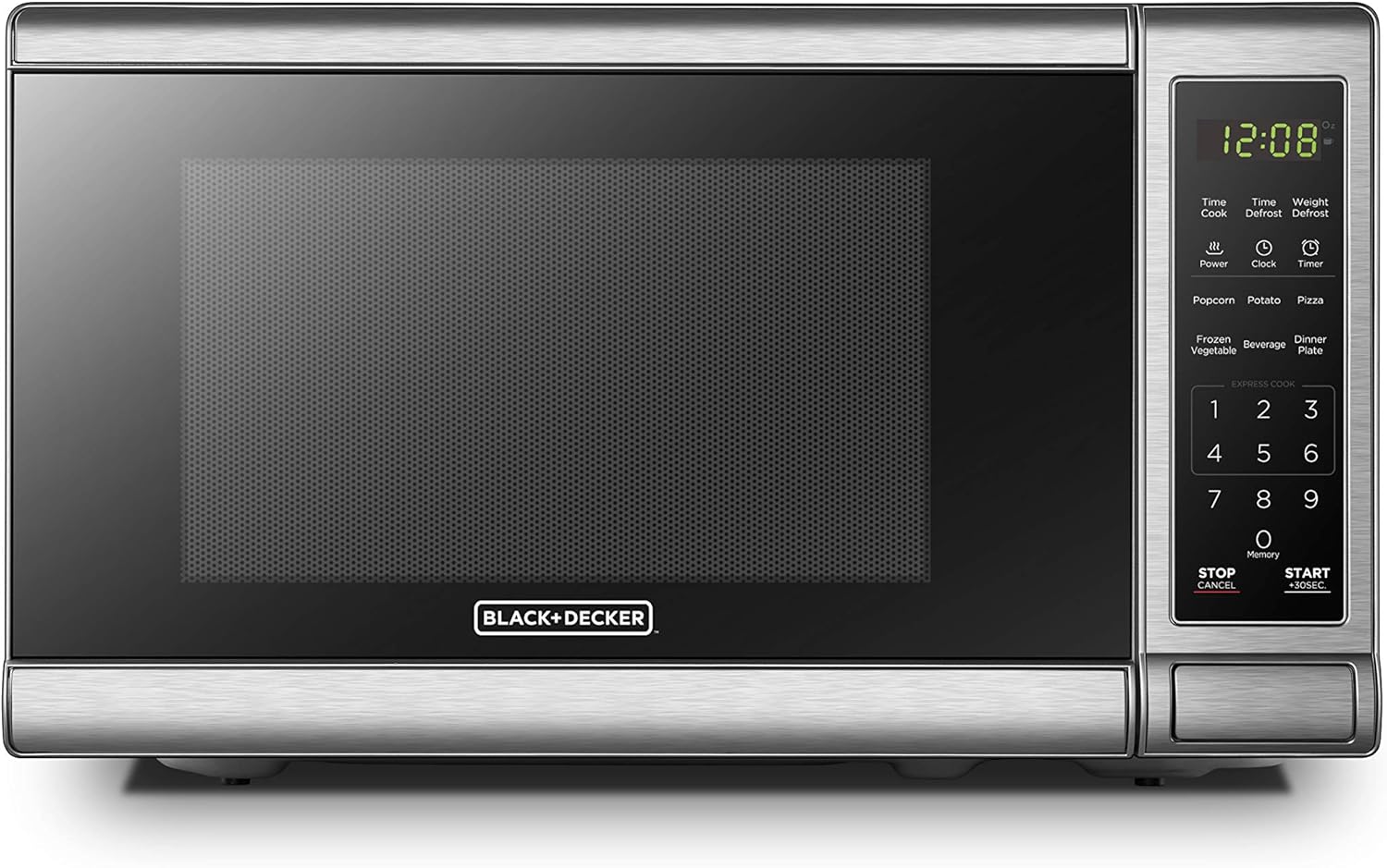
BLACK+DECKER EM720CB7 0.7 Cu Ft Microwave
A small 700-watt microwave for dorms, offices and RVs.
Check price on AmazonSee all nine in our best microwaves guide.
Tips for Even Microwave Cooking
- Cover food loosely to trap steam, and stir or turn it halfway.
- Arrange thicker parts toward the outside of the plate.
- Let food stand for a minute or two after cooking; it keeps heating.
- Reheat leftovers to 165°F (74°C) in the center; the meat temperature chart has other safe temperatures.
- Use microwave-safe containers; read can you microwave Styrofoam before reheating takeout.
Quick ideas for any wattage: steam broccoli, poach an egg in a minute or defrost chicken safely.
Microwave Wattage FAQ
What wattage is a normal microwave?
Most full-size countertop microwaves are 1,000 to 1,200 watts. Compact models are usually 600 to 800 watts.
Is a 700-watt microwave good enough?
For reheating, drinks and small portions, yes, but it is slower: add time to package directions written for higher wattage.
How do I convert microwave cooking times?
Multiply the package time by the package wattage, then divide by your microwave’s wattage. The chart above does it for common times.
Does higher wattage use more electricity?
It draws more power while running, but cooks faster, so the energy used for the same food is similar.
Why does my food heat unevenly?
Microwaves heat unevenly by nature. Cover food, stir or turn it halfway, use a lower power level for dense foods and let it stand before eating.
Affiliate disclosure: This article contains affiliate links. If you buy through them, Menu Moments may earn a commission at no extra cost to you. Specifications, prices and availability change; check the current details on the product page.
Enjoyed this tip?
A weekly hit of kitchen know-how.
Tips, techniques and small upgrades — every Sunday.
Keep reading
You might also like
 →
Free Thermomix® Recipes & Cooking Tips – TM6, TM5, Cookidoo® & Alyce Alexandra
Learn how to cook, create, discover free thermomix recipes and even use resources related to alyce alexandra and the cookidoo® machine.
· 8 min read
 →
Recipe Guide Heartumental: A Mindful Approach to Cooking at Home
Cooking at home is more than just a necessity it’s a powerful, emotional practice that nourishes both the body and the soul.
· 15 min read
 →
How to Boil Eggs: Make the Perfect Hard Boiled Egg
When it comes to quick, nutritious, and versatile foods, nothing quite compares to eggs.
· 7 min read